Agentic AI in 2026: What It Is, How AI Agents Work, and How to Build a Career in AI Engineering
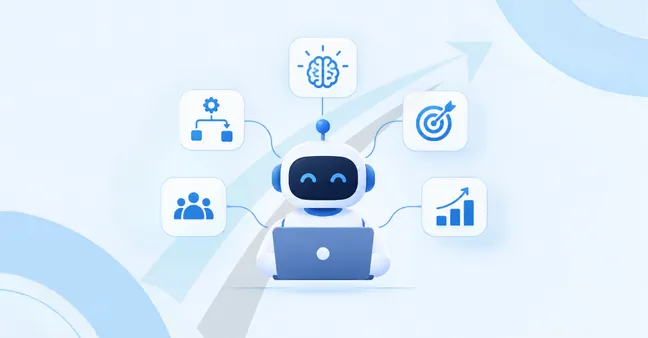
Agentic AI refers to the situation when an AI system is programmed to act autonomously to complete a complicated task. The system estimates the tasks it is completing, divides the tasks, selects proper instruments to do its subtasks, and adjusts its strategy according to the preliminary results. Contrary to the traditional Generative AI framework, which only produces texts or code in response to prompts, an agentic system is an autonomous next-generation decision-making entity. It can do various actions and can act beyond the confines of language models; therefore, focusing on the practical application rather than the production of content.
For those who are curious about the technical features of this evolution, our article
AI Agents: What Are They and How Do AI Agents Work? explores the underpinnings of current intelligent systems and discusses the potential technologies behind AI Agents.
What Is Agentic AI?
An Agentic AI is essentially a model of the interactions of AI and software ecosystems. Conventional AI functions mostly on a transactional basis: give the system a prompt, try to guess the answer (text, code block, image).
● Goal Decomposition: Partitioning a big goal into smaller subgoals.
● Planning & Strategy: Defining the best order of operations, and identifying required resources:Planning & Strategy: Planning a series of actions and choosing the appropriate resources:
● Tool Usage: Accessing external software API, databases, browsers or execution environments.
● Reflection & Feedback Loops: checking work for each sub-task; identifying errors or missing information and modifying strategy as needed.
Understanding how AI Agents Operate
To illustrate the workings of an AI agent, consider a business example where an AI agent needs to perform the function of creating an industry brief for its team leader. It does not simply rely on its memory when doing this; rather, it follows a cognitive cycle.
Learn to determine the meaning of goals and plan tasks.
On the user's request the underlying orchestrator will interpret the intent. The system develops the execution plan that is going to be followed in a multi-step process, specifying the data that is needed, which tools are needed, and conditions for success.
LLMs and Decision-Making
The Large Language Model (LLM) is the agent's "reasoning engine" that drives forward the entire. The LLM can be utilized to make decisions, such as making a particular API call or assessing if an output retrieved from it meets the initial sub-goal, but can also be used as a support tool to contextualize inputs, evaluate options and return a decision, without being considered the application itself.
Memory and Context Management
Short term memory and long term memory must be retained by the agent, where short term memory refers to the memory that is used for storing the current state in multi-steps execution loops and long term memory is for storing historical interactions and preferences of the user.
Use Tool Calling, APIs, and External Data Access.
Tools play a role for AI agents to be helpful. An LLM can initiate calls to REST APIs externally, perform SQL queries on the database, run Python codes in a sandbox environment with schemas, or conduct searches in the internet using schemas like JSON function calls.
Execution, Feedback, and Evaluation
Once a tool has returned a result the agent checks the result. When the API encounters an error or provides missing information, the agent assesses the causing error and tries a different method – for example modifying the search query or using another tool that is available.
In accordance with human Approval and Safeguards.
Human Approval and Safeguards
Responsible agent design adds human approval elements to high consequence operations that include such uses as sending outbound email, updating production databases, or approving financial transactions. When an agent halts execution, it reports the action that it would like to perform to a human supervisor, and it will only resume execution if so authorized.
RAG is a vital part of Agent Workflows
Especially, in the use cases where agents get endowed with knowledge about the application domain, retrieval augmented generation (RAG) becomes very essential. RAG offers the context using external data sources which are neither in the vector database nor in the documentation repository as the grounding, whereas the agentic model controls how and when to retrieve and process the data along with invoking the appropriate downstream tool.
Agentic AI vs. Generative AI vs. Traditional Chatbots
Understanding the distinctions between these AI approaches helps clarify where agentic architecture fits into modern software engineering.
Real-World Applications of Agentic AI
Organisations are adopting the concept of Agentic Architecture for various processes in order to save effort without compromising on supervision:
● Customer Support Triage & Resolution: The Customer Support agents use a CRM database to gain access to the customer data, diagnose using a diagnosis API, and either solve the problem or provide a structured summary to the human Customer Support agent.
● Software Engineering & Automated Debugging: Support developers take a bug report, determine the files needed from a repository, run local tests, and make suggestions with changes to the code in the form of patches.
● Research & Document Analysis: Legal & Financial search agents review hundreds of unstructured documents, pick out important data regarding a broad spectrum of financial measurements, authenticate these documents through external sources, and create structured compliance reports.
● IT Operations & Cyber Defense: Security agents watch out for telemetry data, match any suspicious activity against threat intelligence feeds, quarantine any affected virtual machines, and send data to human security analysts.. Building defensive infrastructure may involve domain-specific training for Cybersecurity & Ethical Hacking agents.
What Is the best way to automate business: Agentic AI or RPA?
AI and RPA solutions are both important for enterprise automation and should be viewed as complementary technologies. Below you can see what the common use cases for each technology are:
● RPA (Robotic Process Automation): RPA is best suited for processes that are repetitive and follow set rules, usually those located in the backend. RPA scripts are very sensitive to any change made to the UI or API response.
● Agentic AI: Best suited in situations where some form of structure is involved in the interactions along with common sense or context. Agentic AI works well for processes that require analysis of unstructured data or use of dynamic tools.
It is expected that in today’s organizations, the Agentic AI and RPA will be integrated in the automation process whereby the Agentic AI will be playing a key role by being the main intelligence element of the system, whereas the RPA will handle the back-end functions.
Essential Skills and Tools for AI Engineering
To create production-ready AI agents, you need a combination of a proper foundational software engineering mindset and a set of specialized AI frameworks. The main technical competencies needed to become an AI engineer are:
Python & API Development
You should be proficient in Python in your agent orchestrator role, including asynchronous development, type hinting, object orientation, and RESTful API consumption
LLMs, Prompt Engineering & Structured Outputs
Understanding token limits, context windows, prompt construction, and enforcing JSON/Pedantic structured outputs to make agent decisions align neatly with software functions.
Embeddings, Vector DBs & RAG
Vector embeddings storing and searching using third-party tools like Pinecone, ChromaDB, or Qdrant to facilitate external retrieval mechanisms.
LangChain & LangGraph
● LangChain: provides a set of modular building blocks, data loaders, and connection tools to tie models to external data stores.
● LangGraph: a specialized framework built around constructing stateful cyclic graph multi-actor agent systems capable of handling loops, state, and human interaction.
Application Backends & Deployments
Deploy agentic workflows as a lightweight web service API, such as FastAPI, containerize the application using Docker, and host the application on a cloud platform such as AWS/Azure. You can also consider adopting strong cloud operations practices, which are similar to some abilities required by DevOps and Cloud Computing roles.
How to Start a Career in Agentic AI Engineering
The way to start your career in AI engineering is through a carefully constructed learning path centered around software engineering competencies rather than superficial framework usage. For a full list of requirements, you can check out our comprehensive AI Engineer Roadmap 2026: Skills, Tools & Career Path.
● 1. Strengthen software engineering foundations: master Python, data structures, Git version control, API development (FastAPI).
● 2. Learn ML & LLM Concepts: understand how transformer models work, how to call frontier API models, and how context windowing works.
● 3. Learn RAG Building: build vector search applications over private document bases before building agentic orchestrations.
● 4. Learn Stateful Agent Development: learn to develop agents that can make branching decisions and execute tools using a framework such as LangGraph.
● 5. Learn Security, Testing & Guardrails: Learn prompt injection defenses, output validation, deterministic testing, and cost management features.
● 6. Build a Technical Portfolio: Build interesting applications that demonstrate your ability to solve engineering problems.
Learn Agentic AI with the SkyStates Professional Program
For those that are looking for a mentor-guided learning pathway, the SkyStates Agentic AI & Generative AI Professional Program offers an intensive six-month live training curriculum that aids in transitioning developers and technical professionals into AI engineering roles.
Program Core Curriculum Highlights
● Generative AI & LLM Foundations: Introduction to core concepts, API orchestration, and structured output formatting.
● Advanced RAG Systems: Working with vector databases, hybrid retrieval, and semantic indexing.
● Agentic Architecture & Multi-Agent Systems: Building stateful orchestrations using LangChain and LangGraph.
● Production Backend & Deployment: Building backend microservices using Python and FastAPI, and deploying to cloud infrastructure.
What the Program Offers
● Live Interactive Workshops: Instructor-led sessions with Q&A and code walkthroughs.
● Portfolio Project Development: Hands-on projects to build out your AI engineering portfolio.
● Career Assistance: Assistance with resume building, LinkedIn optimization, technical interview prep, and placement guidance.
● Comprehensive Skill Ecosystem: Designed to complement the foundational skills offered across the Data Science & AI programs.
Students can look at the student feedback and training account reports published on SkyReviews to learn more about technical learning experiences across SkyStates educational offerings.
Frequently Asked Questions About Agentic AI
What are the main applications and use cases for Agentic AI today?
Agentic AI is used mainly in multi-step processes which involve tool interactions and contextual evaluation. It may be in technical customer service triage, isolating software bugs and creating pull requests, document research, financial report analysis, or IT logging.
What technical components are required to build an Agentic AI system?
The six major elements that need to be considered for the creation of an agentic system include:
LLM Reasoning Engine
Task Planning System
Short/Long Term Memory State Management
External Tools/APIs
Context Retrieval System (e.g. RAG)
Evaluation/Guardrail System
What are the safety, ethical, and governance concerns with Agentic AI?
Safety, ethical and governance issues revolve around decision making through hallucinations, unpredictable tool usage, vulnerability to prompt injections, data breaches and excessive API privileges for agents. Human-in-the-loop controls, restricted API privileges for agents and logging are some of the measures needed.
How can developers test and validate Agentic AI behavior?
Because agents can have non-deterministic execution paths, testing involves analyzing specific intermediate tool calls, running regression benchmark datasets, verifying structured output adherence, testing failure recovery paths, and using LLM-as-a-judge evaluation frameworks.
Start Building Your Agentic AI Skills
The creation of agentic AI represents a fundamental paradigm shift in software design in that the systems are no longer passive tools but operational collaborators. To build a successful career in this emerging space, you need to be proficient in software engineering foundations, stateful agent frameworks, vector retrieval, and production system safety.
If you are ready to take a structured step forward in your career, explore the detailed curriculum of the SkyStates Agentic AI & Generative AI Professional Program and speak with an advisor to evaluate your learning pathway today.