AI Engineer Roadmap 2026: Skills, Tools & Career Path
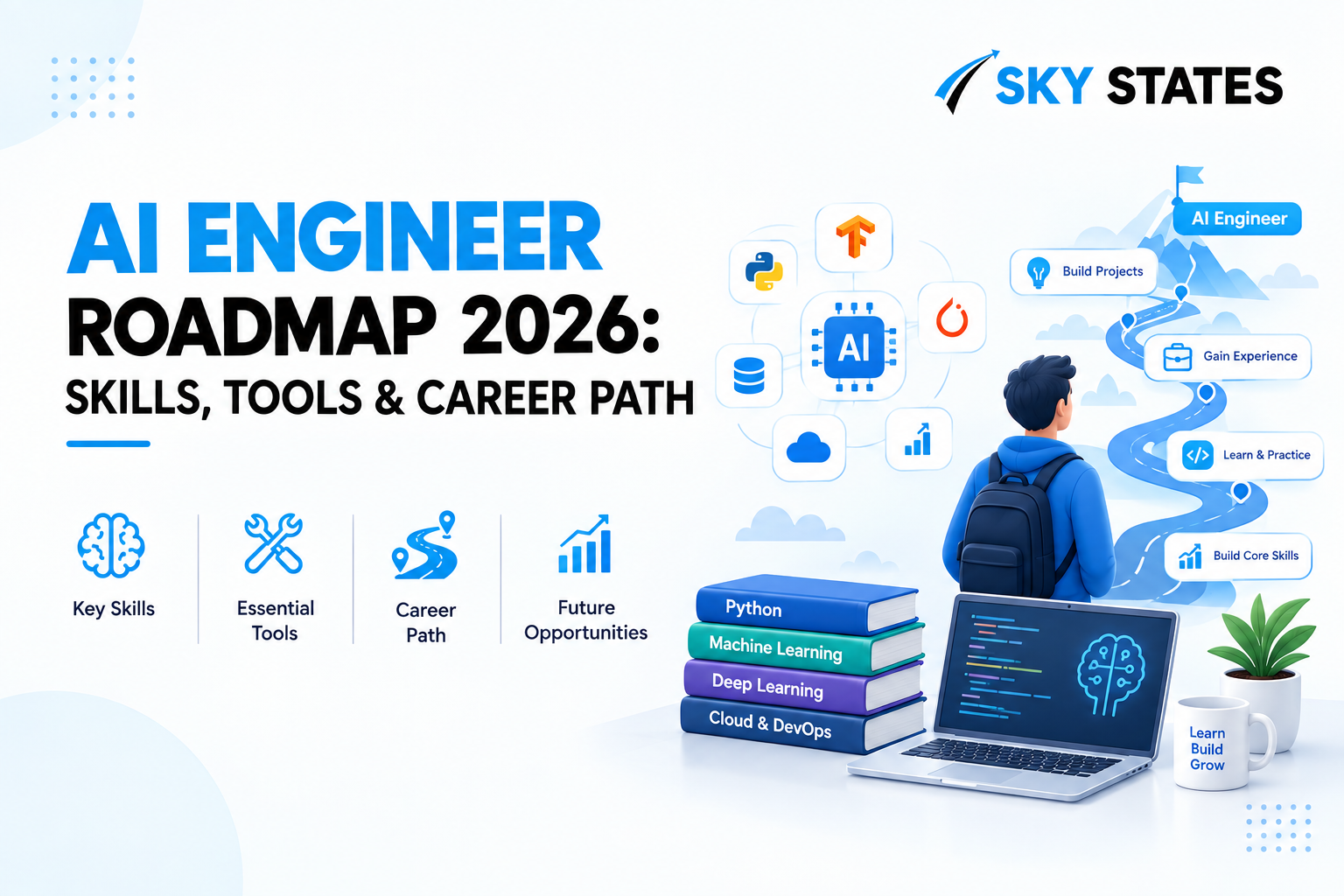
AI Engineering roles are growing quickly in the technology industry today, making them among the most in-demand jobs in the world. AI Engineering includes concepts from software development, machine learning, Generative AI, and data handling. As AI becomes smarter quickly, humans have to keep up with a lot of new skills to stand out in the job market. But the job market supports people who have advanced skills and constantly upskill themselves with changing expectations.
In this blog, users will be guided through the complete AI Engineer Roadmap and AI Engineer skills, and learn how to become an AI Engineer.
What is an AI Engineer?
An AI Engineer is a technology professional who builds and manages AI-powered applications and systems. They use programming, machine learning, and other AI technologies to solve problems, complete tasks, and automate daily work. Basically, an AI Engineer understands and analyzes concepts from various domains and use it to make a real application. Some of the examples of applications include AI Chatbots, Virtual Assistants, applications for business, etc.
What does an AI Engineer do?
Develop AI Models
Create AI-powered solutions such as chatbots, virtual systems, prediction tools, and automation applications.
Prepare and Analyse
Collect, clean, and organize data so AI models can understand it and produce better results.
Enhance AI Models
Train machine learning and deep learning models with data to enhance and improve them to create accurate results.
Add AI to the applications
Connect AI models with websites, mobile apps, business software, and other applications so users can easily access AI features.
Test AI Systems
Test AI applications to make sure they provide correct results and work properly before they are released to users.
Deploy AI Applications
Make AI applications available for real-world use by deploying them on servers or cloud platforms.
Monitor Performance
Keep track of the AI system after deployment to check its accuracy, speed, reliability, and overall performance.
Update AI Systems
Find and fix problems, update AI models, and improve applications when new data or requirements become available.
Team Collaboration
Work with software developers, data scientists, data engineers, and business teams to develop AI solutions that meet business and user needs.
AI Engineer Roadmap 2026
Step 1: Build Foundation
Start by learning programming concepts, which are the foundation of an AI Engineer. Start by learning Python, as it is a common language to learn for beginners in Artificial Intelligence and Machine Learning.
Learn these basic concepts to complete the foundation:
Python syntax, variables, loops, and functions
Data structures and object-oriented programming
File and error handling
SQL for accessing and managing data
Git and GitHub for managing code
Basic command-line and Linux concepts
Step 2: Use of Mathematics and Data
Any preparation and development of an application requires basic analysis of data. Data usually requires mathematics, including statistics, probability, linear algebra, and calculus, which makes machine learning easier to understand.
Users are suggested to use the following for:
NumPy for numerical operations
Pandas for cleaning and managing datasets
Matplotlib for data visualization
SQL for retrieving information from databases
Step 3: Understanding Machine Learning
Once the mathematical concepts are clear and you have started using them with data for analysis, you need to clarify your machine learning foundation concepts. This will help you learn patterns from the information already given and identify and make future predictions.
Learn these concepts:
Supervised and unsupervised learning
Regression and classification
Clustering
Feature engineering
Training and testing datasets
Model evaluation
Overfitting and underfitting
Step 4: Learning Deep Learning
Once the traditional machine learning concepts are clear, learn the deep learning concepts to understand the technology behind the AI applications.
Understand these concepts:
Artificial neural networks
Activation and loss functions
Backpropagation
Convolutional Neural Networks (CNNs)
Natural Language Processing (NLP)
Transformers
Step 5: Working with Generative AI and LLMs
Gen AI and LLMs (Large Language Models) are an important part of learning AI engineering. Learning these will help you integrate it into the real applications.
It includes:
Large Language Models
Prompt engineering
Tokens and context windows
Embeddings
LLM APIs
Structured outputs and function calling
Model selection and evaluation
Step 6:Build RAG Systems and AI Agents
Once you understand LLMs, learn how AI applications can access external information, use tools, and complete multiple tasks.
Explore technologies such as:
Retrieval-Augmented Generation (RAG)
Vector embeddings and semantic search
Vector databases such as Pinecone, Chroma, and FAISS
LangChain and LlamaIndex
AI agents and tool calling
LangGraph for agent-based workflows
Step 7:Learn APIs, Deployment, and Cloud
A professional AI engineer should know how to take an AI project from their computer and make it available to real users.
Learn:
FastAPI for creating APIs
REST APIs and JSON
Docker for packaging applications
Basic Kubernetes concepts
Cloud platforms such as AWS, Microsoft Azure, or Google Cloud
Databases and application storage
Step 8:Understand MLOps and AI Monitoring
Once an AI application is deployed, it needs to be monitored and maintained. This is where MLOps and LLMOps become important.
Learn how to:
Track model performance
Monitor accuracy and errors
Evaluate LLM responses
Identify model or data drift
Manage model versions
Reduce AI response time
Monitor API and inference costs
Update models safely
Step 9: Creating AI Portfolio
After learning the concepts and understanding the working process, create a few projects that are practical and not just theory-based. The projects must include a particular problem and how that problem has been solved with everything you have learned. Publish your projects on GitHub, add clear information and working projects, and explain the technologies used.
AI Engineers' Tools to Learn Skills in 2026
Programming: Python, SQL
Data: Pandas, NumPy
Machine Learning: Scikit-learn
Deep Learning: PyTorch, TensorFlow
Generative AI: LLM APIs, Hugging Face
RAG & Agents: LangChain, LlamaIndex, LangGraph
Vector Databases: Pinecone, Chroma, FAISS
Development: Git, GitHub, REST APIs, FastAPI
Deployment: Docker, AWS, Azure, Google Cloud
Monitoring & Operations: LLMOps and model evaluation tools
What are Different Career Paths After AI Engineering?
An AI Engineer career may take you to different roles depending on the skills you develop and your specialization.
AI Engineer
Build, test, and deploy AI-powered applications that solve real-world business problems.
Machine Learning Engineer
Develop and improve machine learning models that can learn from data and make predictions or decisions.
Generative AI Engineer
Build applications using LLMs and generative AI, such as AI assistants, content-generation tools, and intelligent automation systems.
LLM Engineer
Work specifically with Large Language Models, including model integration, prompt engineering, RAG, fine-tuning, and LLM evaluation.
NLP Engineer
Develop AI systems that can understand and process human language, such as chatbots, translation tools, and text-analysis applications.Computer Vision Engineer
Build AI solutions that can understand images and videos for tasks such as object detection, image recognition, and visual analysis.
MLOps Engineer
Manage the deployment, monitoring, maintenance, and scaling of machine learning models in production environments.
AI Solutions Architect
Design complete AI systems for organizations by selecting suitable models, cloud services, databases, APIs, and other technologies.
© 2026 Sky States LLC Institutional Excellence in Technology. All rights reserved.
