AI Agents: What Are They and How Do AI Agents Work?
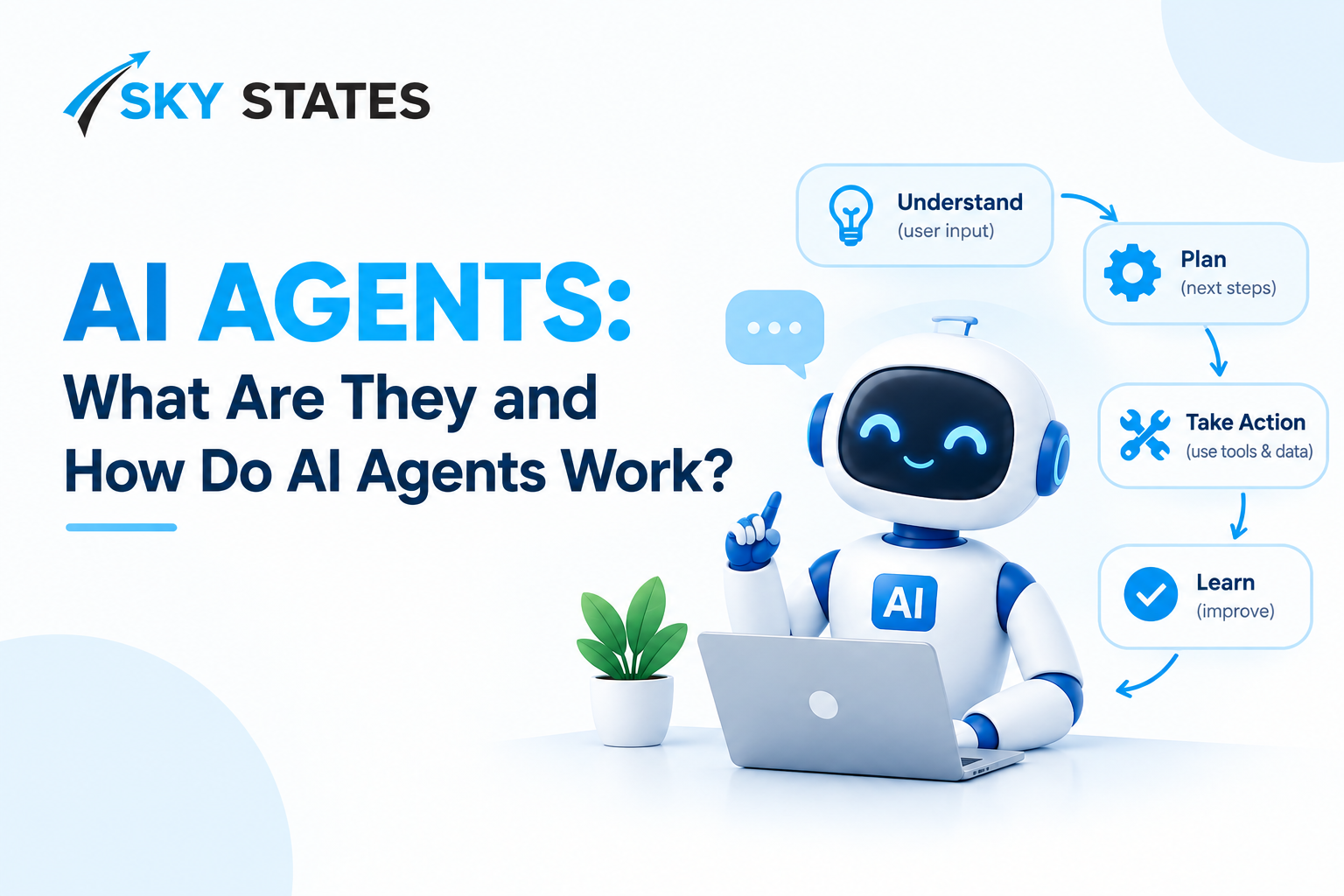
In the past, "AI" meant a chatbot that just answered your query and that was it. You ask the question; the chatbot replies, the conversation is over. However, this is no longer the case today. Contemporary conversations about AI include AI Agents, that help not just with answering questions but also carry out actions like scheduling a meeting, gathering necessary information from various sources, preparing a report, and sending it to the proper recipient without manual operation of any of these activities.
You may have heard this term recently but not entirely understood the difference between AI agents and a standard chatbot. Let us try to find out what is the difference between them by examining some details of technology used for AI agents.
What Are AI Agents?
To understand AI agents, we first need to understand what they are really about; that is, an AI agent is a software entity that has been designed to achieve some goal independently. Instead of being programmed step by step, the AI agent analyzes a task, determines the actions it should take next, executes the appropriate action, checks whether the task has been executed properly, and makes necessary adjustments.
Now, let's compare this to a traditional chatbot. You interact with chatbots by asking them questions, and they simply provide you with answers according to their learning. The situation is different with an AI agent, which receives a question from you and performs a series of actions to process it and get the final outcome.
This is basically how agentic AI works, the system is equipped with enough knowledge and tools to process tasks automatically without requiring human supervision. The Principle of AI Agent Operation, Despite the complexity of AI agents, they consist of a basic set of components that allow us to understand their unique behavior.
Layer of Perception/Input
This layer is critical for agents because it encodes the information they need to process such as the text input from a user, information retrieved from some API, a text document, or live updates from another system. Without the information encoded in this layer, the agent has nothing to work with.
Layer of Reasoning/Planning
At the next stage of working with the information, agents must think: they must assess the goal of their operation, what strategy they intend to employ, and how they are going to act. Many modern agents implement large language models that have been proven to perform well at breaking down vague objectives into specific steps required to achieve them.
To better understand the technologies behind modern AI systems, it is also useful to understand the relationship between machine learning and deep learning and how the two approaches differ.
For anyone preparing for an AI-related role, it is also important to understand how these concepts are discussed in technical interviews. You can also review our AI interview questions and answers for freshers to prepare for common interview topics.
If you are planning a career in this field, understanding the skills, tools, and career path involved can be a useful starting point. Our AI Engineer Roadmap 2026 covers the key skills and technologies you should learn.
Memory
Agents utilize memory to store only the current communication, but sophisticated systems have layers of memory which may be applied to either one-time communication or communication happening across multiple sessions. In such a way, agents do not lose context.
Layer of Tool Use/Action
This layer seems to distinguish agents from the chatbots. Agents can utilize various external tools for performing various tasks as agents perform specialized operations as opposed to mere chatting.
AI agents often rely on programming languages and frameworks to connect with APIs, process data, and interact with external tools. Python libraries for data science are especially useful for building AI and data-driven applications.
Layer of Feedback and Self-Correction
After taking an action, a well-designed agent checks whether it worked. If a step fails or the output doesn't match the goal, it can retry, adjust its plan, or escalate to a human if needed.
Put those five pieces together, and you get something that looks less like a Q&A bot and more like a junior employee that can handle a task from start to finish, with varying levels of supervision depending on how it's set up.
Typical AI Agents You Might Have Encountered
When it comes to architecture, theory accounts for a lot, but there are numerous practical examples when it comes to understanding the concept:
Customer support agents need not only answer questions about orders, refunds, and complaints, they can retrieve the necessary information using the internet. Coding assists read the entire code, make modifications in the many files, run diagnostics, and eliminate the mistakes without assistance.
Research agents look up a specific issue and find all the different viewpoints with the help of online sources. Scheduling agents can negotiate between calendars and send emails after that. Sales agents also assist these and send emails to clients, checking their responses and trying to adjust their follow-ups based on how the clients engage.
None of these are science fiction at this point. They're already running inside businesses that have adopted AI automation tools to cut down on repetitive manual work.
Where AI Agent Applications Are Making the Most Impact
The applications of AI agents continue to expand but in certain domains, some differences can already be seen:
In customer service, AI agents are able to address a significant number of routine questions without human intervention. In software engineering, coding agents assist in software debugging and the execution of repetitive programming actions. In operations and back-office functions, agents carry out tasks like entering records into the database, performing reconciliation, and conducting reporting which previously took many hours.
In marketing, AI agents manage the process of campaign preparation, creation of content, and the measurement of campaign performance. In personal productivity, the agents take charge of email boxes, calendars, and to-do lists needing minimal human intervention.
These examples are united by the same common ground. In contrast to tools that require instructions, an AI agent system is characterized by the ability to execute the workflow of the agents independently and with a minimum amount of assistance.
It’s essential to delineate autonomous AI agents from automation as even though automation is not a novelty anymore, the ability of autonomous AI agents to be flexible makes it different from traditional automation.
Typical automation scripts adhere to a prescribed sequence of events: if something happens, then we execute a certain action. As soon as something unforeseen occurs, the method fails completely. However, an intelligent agent will work well in circumstances for which it was not particularly programmed because it operates not through a set of fixed rules, but through reasoning. For instance, in each moment, the intelligent agent will know what course of action will likely lead to achieving its objective.
This is the crux of agentic workflows: solving the problem of how to perform a task instead of prescribing exactly what to do.
A Few Things Worth Knowing Before You Adopt AI Agents
Before getting fully immersed in this promising process, it is worth noting that AI agents are not perfect either. They can misinterpret a goal, loop in wrong actions, or do something that technically fulfills a task, yet fails to achieve it properly. Normally, an AI agent is implemented in a system with a number of limitations for a human to intervene if an important action is required.
To Conclude
To answer the original query, AI agents can be defined as systems capable of taking a goal, determining the steps to attain the goal, utilizing tools to take action, and then adjusting the process throughout most of the journey without the constant presence of human supervision. This means we are progressing beyond having chatbots simply capable of producing answers. As many companies start using intelligent agents to do actual work, it will become increasingly important to understand the construction of intelligent agents and what they can deliver as opposed to treating the term as yet another trend in contemporary vocabulary.
Ready to explore what AI agents can do for your business? From automating repetitive workflows to supporting smarter, more efficient operations, AI agents can help organizations move beyond traditional automation.
Discover how modern AI solutions can support your business goals with Sky States.
Explore Sky States today and take the next step toward smarter AI-powered automation.
Frequently Asked Questions (FAQs)
Q1. What are AI agents in simple terms?
Ans. An AI agent is a software system that can understand a goal, plan the steps to achieve it, take actions using available tools, and adjust based on results, largely without step-by-step human instructions.
Q2. How is an AI agent different from a chatbot?
Ans. A chatbot typically responds to a message and stops there. An AI agent can break a task into steps, use external tools to complete them, and keep working until the actual goal is achieved, not just answered.
Q3. What are some real AI agent examples?
Ans. Common examples include customer support agents that resolve tickets independently, coding assistants that edit and test code, research agents that compile reports, and scheduling agents that coordinate meetings.
Q4. Are AI agents fully autonomous?
Ans. Not usually, at least not by default. Most practical setups include some level of human oversight or approval for higher-stakes actions, even though the agent can operate independently for most of the process.
Q5. What industries benefit most from AI agent applications?
Ans. Customer service, software development, operations, marketing, and personal productivity are among the areas seeing the most adoption right now, largely because they involve repetitive, well-defined tasks that agents can handle end-to-end.
