Agentic AI Application Architecture: Design Patterns, Tool Integration & Deployment
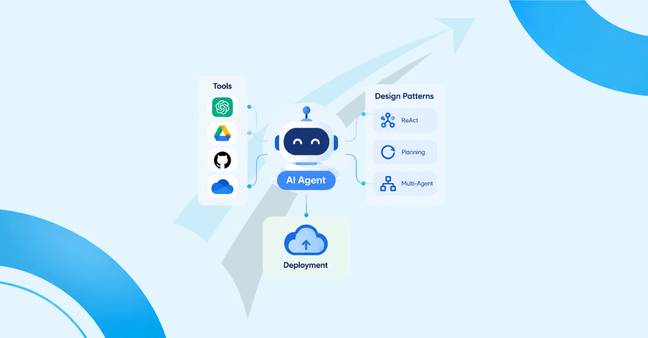
Creating software systems that use generative intelligence requires far more than simple prompt-response chat loops. Agentic AI application architecture is the design of software where independent Large Language Model (LLM) agents plan, think, call tools, keep track of state and execute multi-step workflows so that developers can reach complex open-ended goals. When building Agentic AI application architecture it is important to view the Large Language Model (LLM) not as a block of code but as the main reasoning engine inside a strong, error‑resistant and safe software engineering structure.
Quick Answer : Agentic AI application architecture is the software engineering pattern that merges a Large Language Model (LLM) reasoning core with state control tools, from long-term memory and safety rules. Agentic AI application architecture lets applications carry out -step workflows by themselves, choose what to do at run time and call external APIs while staying predictable, fixing mistakes and keeping operations safe.
What Makes an Agentic AI Application Architecture Different?
Agentic AI Application Architecture is different from software applications because it does not follow a strict deterministic control flow. Traditional software applications have every conditional branch and state transition coded in advance. Standard LLM integrations use single-turn inference calls; the application sends a prompt. Then reads the returned text. Agentic AI systems mix these approaches by adding execution loops.
In an AI Application Architecture the foundation model acts as a reasoning engine but for a real production system you still need extra infrastructure. You need state managers to keep track of -step execution API wrappers so the model can talk to databases, retrieval systems to ground the model’s answers, validation layers to catch bad outputs and operational guardrails to stop infinite loops or dangerous tool calls. If a developer wants to explore the ecosystem, understanding how Agentic AI systems work.
The Six Building Blocks of an AI Agent System
A production-grade agentic system relies on six distinct architectural components working in concert:

Figure 1: Architectural Building Blocks of an Agentic AI Application
Model and instruction layer
Each developer will have to specify the following. System prompt: Set the behaviors of the foundation model. Role instructions: Set instructions about the role of the chatbot or assistant. JSON mode or tool schema: System outputs should not be contained in chat-like dialogue, but rather be predictable, parseable JSON.
Orchestration and state management
Agents run over several turns. An orchestration layer is responsible for monitoring task completion, recording State, branching and retrying if a tool fails, and knowing when the task is complete. Without managing the State, agents get stuck or lose context.
Tools, APIs, and permissions
Agents connect to the outside world through tool calling. Each foreign function, whether a SQL query generator, email sender, or Kubernetes CLI wrapper, should have tightly validated input schemas, typed parameters, and no more than scoped permissions to execute.
Knowledge retrieval and memory
Applications should isolate stateless RAG from persistent conversational memory. Retrieval Augmented Generation pulls in external factual knowledge from vector stores, and short- and long-term memory architectures can keep a record of the session state and history of user preferences.
Safety and human approval
Dangerous autonomous execution can cause significant operational risks. Architecture should include permission boundaries, deterministic validation tests, and asynchronous review checks that will suspend the execution of agents until checked and cleared by a human operator.
Ops, Logging & Observability
Agent-specific logging may not work because the decision-making path is non-deterministic. All developers have to do is hook their favorite trace so that they can see the sequence of reasoning steps, tool invocation latency, token count, and states.
Choosing the Right Agentic AI Design Pattern
Selecting an appropriate pattern prevents over-engineering. The following table compares four common architectural patterns:
More agents won't necessarily give you better results. Developers should always try to be as simple as possible, using the simplest architecture that can handle the task complexity, latency requirements, and cost budget. Various frameworks such as Lang Chain, Lang Graph, CrewAI, and Auto Gen can be used as building blocks for these types of pattern, but they are specialized tools-Lang Graph is great for stateful cyclic graphs, and CrewAI for role-playing multi-agent work.
Prototype to production: an effective development process
Building production-ready agentic systems requires a disciplined software engineering lifecycle:
1. Explicitly define the domain of the task, the user personas it is designed for, boundaries within which it operates, and metrics used for evaluation.
2. Map data sources and tools: Map enterprise APIs, data stores, and third-party tools you will use and set least-privilege access for those endpoints.
3. Select architectural pattern: use the least complex workflow or agent pattern that meets the functional needs.
4. Implement and integrate: Construct core logic, integrating vector retrieval to help ground Knowledge, and coherent memory stores.
5. Test and harden: Test edge cases, fire drill the failure modes, validate loop detection, and set human-in-the-loop approval gates for all high risk actions.
6. Containerize the application, configure the endpoints, and set up continuous monitoring.
The serving layer we plan to use FastAPI because of its async capabilities, API auto-documentation using OpenAPI, and native support for Pydantic data validation that matches JSON schemas used for LLM tool calls.
For packaging, Docker provides portable execution environments that can run both on local development clusters as well as in production cloud clusters. Deployment will primarily be done with container orchestration services on AWS (ECS/EKS), Azure (AKS), or Google Cloud (GKE), integrating strongly with DevOps and cloud computing skills for infrastructure management.
Five Architecture Mistakes to Avoid
1. Over-engineering with multi-agent swarms: Creating intricate multi-agent hierarchies when a single agent using prompt loops or deterministic workflows would get the job done. This results in unused compute and less predictable failures.
2. Giving the tool tools too much power: Providing agents free reign over all database write access or shell execution without careful input validation, sandboxing, and.authentication & authorization checks.
3. Assuming fetched data is the absolute truth: Without fact-checking the cited sources or validating the data, blindly taking fetched information from RAG or searching from the web.
4. Not combining circuit breakers and maximum iteration limits, including not catching exceptions on malformed model outputs or broken API calls, which risks getting stuck in a loop.
5. Going into production without observability: Releasing autonomous systems without distributed tracing, cost tracking, and safety guardrails so you can't perform root-cause analysis for when errors occur.
Where to Develop Practical Agentic AI Engineering Skills
Hands-on experience in real-world applications of these architectural principles, especially in backend engineering, prompt engineering, containerization, and orchestration tools, is crucial. For developers interested in the Agentic AI career roadmap, targeted training that integrates foundational Python skills with advanced cloud-native deployment expertise is essential.
Achieve production-grade knowledge with the Sky States Agentic AI & Generative AI Professional Program. An end-to-end curriculum on Python, fundamental LLM technologies, RAG architectures, Lang Chain, Lang Graph, CrewAI, Auto Gen, designing APIs and tool calling, FastAPI, Docker, cloud, AI safety and testing, and strict evaluation of models. Through live instructor-led workshops, hands-on industry projects, and a final capstone, the program enables engineers to engineer, secure, and release strong intelligent applications.
Frequently Asked Questions
What is Agentic AI application architecture?
Agentic AI architecture refers to how all the components of an agentic AI work in unison. This typically includes the language model, tools, memory, and agentic logic that guides the agent on its next course of action. This architecture enables an application to perform multi-turn tasks as opposed to single-turn response-generation.
How does an AI agent differ from an AI workflow?
An AI workflow generally takes a set course of actions. An AI agent has much more latitude. It can examine the outcome of a step, take it into account, and then choose a different approach. For instance, a workflow might always take the same course to analyse a document, while an agent can determine whether to act based on the current information.
When do developers require a multi-agent architecture?
The multi-agent configuration is appropriate when there are many forms of work that need to be done. For instance, one agent might be responsible for doing research on a subject and another agent would do the writing, and another would look over the output to make sure it was good. One agent might be all you need for simple jobs.
How does RAG and AI agent memory differ?
RAG is the assistant that retrieves information from documents, databases, and other sources when an agent needs information to generate an answer. Memory is an assistant that provides context to an AI agent to keep track of users' past interactions, ongoing tasks, and useful preferences. Simply put, RAG retrieves information, and Memory provides context.
How should developers deploy the AI agent in a safe manner?
Prior to deploying an AI agent, the developer may wish to stress test it against various situations, the tool it can use, and establish boundaries. Certain actions should require human approval. Developers can deploy with Docker, logging, and monitoring to better manage the application and troubleshoot failures.
Conclusion
Developing an AI agent involves more than connecting a language model to an API. It requires a solid understanding of task planning, tool integration, memory management, error handling, security, and performance monitoring. Building expertise in these areas can help you develop reliable AI solutions for real-world business applications.
If you're interested in exploring AI engineering, agentic systems, Retrieval-Augmented Generation (RAG), and Large Language Models (LLMs), the Sky States Agentic AI & Generative AI Professional Program can help you build practical knowledge and develop relevant skills. To learn more about the learning experience and explore feedback from others, visit Sky Reviews for additional insights about Sky States LLC.