How to Pass Tech Job Interviews in 30 Days: A Practical Roadmap
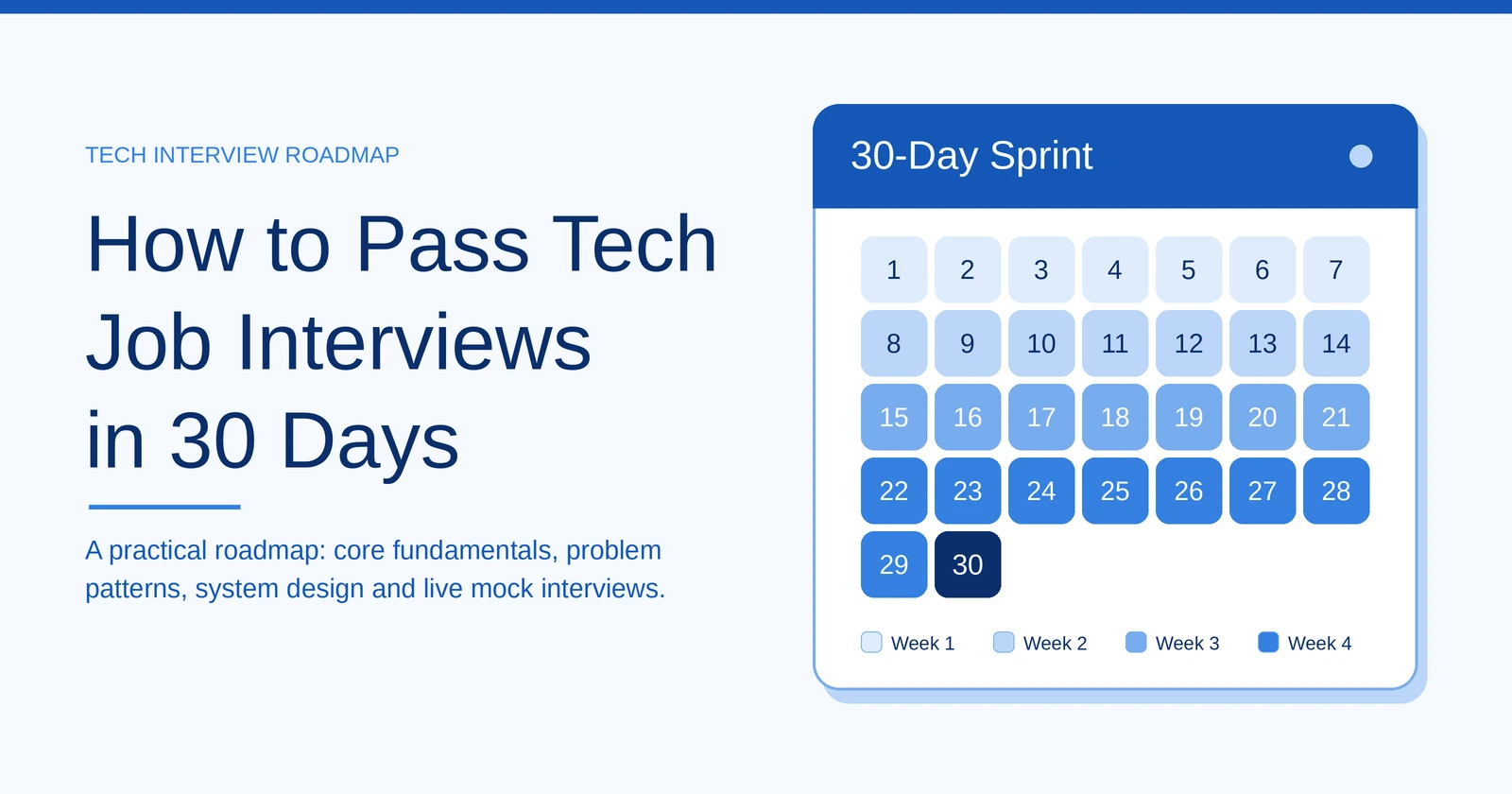
To apply for a technical interview, you have to have a focused approach on high-value technical basics, a daily plan, and an exact and efficient execution for a mock interview to get through the 30-day passing. Rather than memorizing lots of haphazard problems in hundreds of months for trial and error, candidates can focus their learning on the important patterns of algorithms and system design to save their time. This way allows them to focus their learning on the core algorithmic patterns and system design principles rather than memorizing hundreds of haphazard problems over months of study, mainlining it through a four-week intense, highly structured preparation process.
When it comes to prep work from a non-savvy position to an interviewing savvying one, you can get from unprepared to prepared in 30 days by doing away with trial and error. If you are doing a 30-day grind on how to prepare to pass software engineering interviews and how to approach the highly set-up-to-date roles like data science, DevOps, cloud computing, cybersecurity, and more, each day needs to have a different purpose.
Your starting point should be a good base reference document, such as the tech interview handbook, to help you see how you are doing and ensure that your basic fundamentals are up to scratch at all times.
The 30-Day Tech Interview Preparation Sprint.
If you have what feels like a short term, then break the whole month up into four unique 7-day segments. Feel confident your skill sets get tailored on a weekly basis, without burning out.

Week 1: Core Fundamentals & Baseline Audit
The first week is used to identify missing information and to learn the basics of construction blocks. Also, be sure to concentrate on main concepts that yield the largest ROI rather than anyone else spending time on the problems that they can solve.
Software Engineering: QUIZ: Review Data Structures: Arrays, Strings, Hash Maps, Two Pointers, Sliding Window. Know how to write a program with time and space complexity.
Data Science: Refresh some of the linear algebra, probability, SQL joins/aggregations, and core machine learning algorithms (linear/logistic regression, decision trees).
DevOps & Cloud: After reviewing Linux fundamentals, shell scripting, OSI modeling, TCP/IP, DNS, and HTTP/S, know about the basics of containerization using Docker.
Cybersecurity: Principios de Network Security, Threat Modeling (STRIDE), Mechanisms of IAM, OWASP Top 10.
Immediate Action Step: Take a timed diagnostic on Day 1. Take no longer than 2 hours to decide which strengths you have and which to build on or which you need to improve.
Week 2: High Frequency Questions & Problem Patterns
In Week 2, switch your focus in Tech interview prep to identify patterns and how-tos. Rarely will hiring managers expect you to come up with new algorithms that have never been used before; they'd like to see you use existing patterns and adapt them to new circumstances.
Focus more on understanding the structure of the algorithms than on the overall number of questions.
Grouped Practice: Solve clustering of representative tech interview questions across the space of a concept (e.g., DFS/BFS, fast & slow pointers, dynamic programming basics).
Solve problem scenarios that are specific to the domain, such as: Terraform modules, CD failures, feature matrix transformations, and log analysis.
Key Takeaway: If a problem is taking longer than 20 min to come up with a solution, take a break and review the solution approach. Return to the same problem after 2 days for independent recall.
Week 3: Understand the design architecture for a system and how to create domain objects.
System design and domain architecture are especially emphasized in the technical interviews (mid- to senior-level). No matter if you are an entry-level candidate or not, it is a significant competitive advantage to show knowledge of how these individual components work together at a large scale.
Core Infrastructure: Horizontal Scaling and Vertical Scaling, Load Balancing, Database Sharding, Caching Strategies (Redis / Memcached), Message Queues (Kafka / RabbitMQ).
Data Engineering: Design fault-tolerant end-to-end real-time data streaming apps.
DevOps / Cloud Architecture: Design a multi-region auto-scaling cloud infrastructure that deploys without downtime on AWS/GCP.
Learn how to create secure microservices for authentication and authorization based on OAuth2 and JWT.
Actionable Step: Draw architecture diagrams that use an online whiteboard, and verbalize your decisions as you work.
Week 4: Behavioral Framing & Live Mock Interviews.
Not only is being technically proficient not a deal-maker in securing an offer, but being able to explain your thought process when under pressure is as well. Four days before the Super Bowl, it's the last week of converting raw information into real performance.
STAR Framework: Create 5-6 examples of S.T.A.R. stories to be versatile. Work on technical issues, deadlines, project problems, and engineering compromises.
Mock Simulations: Run a minimum of 3-5 live mock interviews with strict time limits.
Verbalization Routine: Exercise skills of verbal logic when coding or whiteboarding. The one thing that can work against a person during an interview is silence.
2. 30-Day or 90-Day Tech Interview Prep: Which Time Frame Is Right for Your Resume?
It's completely up to your background, professional experience, and daily time commitment to decide whether you can go for a quick sprint of 30 days or go for an extended 90 days.

Making the decision to get the 30-DAY PLAN:
Usable Technical Background: You have previous expertise in software development/technical analysis, cloud engineering, or cybersecurity.
Next Interview Window: An upcoming interview is 3-4 weeks away.
Everyday Availability: Take at least 25-30 hours dedicated to studying and practicing on a daily basis.
Choice of the 90-day Plan:
Career Transitions: You don't have a technical background, and you're moving into tech.
You must create original projects to get first call for interviews.
Part-Time Availability: The time you can devote to the day job is reduced to one or two hours (or less).
3. Self-Study for 30 Days vs. Structured Bootcamp & Career Programs

Working in isolation by studying for interviews means you can control the interview preparation activities but means there are hidden disadvantages to self-study preparation, including time lost [wasted] looking for high-quality materials, lack of immediate feedback when hit with a problem, and nowhere to simulate accurate real-time technical communication.
However, students struggle with challenges in the process of solo self-study.
Analysis Paralysis: Overthinking which to do first rather than the high-interest activities.
Uncorrected Flaws: Efficiency problems, communication problems, or poor architecture, etc., aren't discovered until you are rejected by an interviewer.
Learn How Long Do They Last? at 5 hours/day. Learn How Long Do They Last? at 5 hours/day, to overcome them, or to suffer from them: Motivation Fatigue.
Accelerated Results with SkyStates
If you're the type of candidate who struggles with "guesstimating" and has to be completely ready for an interview in 30 days or less, a structured career acceleration program is a no-lose proposition.
This is where SkyStates transforms the preparation journey. SkyStates is designed for tech users and professionals looking to make a change, offering a learning ecosystem that changes the way people learn on their own. Designed specifically for technology users and career changers, SkyStates moves beyond unstructured solo learning to a learning environment based on purpose and outcomes.
Key SkyStates USPs Designed for Fast-Track Success:
Online and Offline training options, flexible learning formats to suit your learning style.
Mentorship and code reviews are tailored to small cohorts of just 8-10 candidates for direct one-on-one mentorship.
Immediate Onboarding: Get started using a New Batch every week, which enables you to take that 30-day countdown as soon as you sign up.
Lifetime Mentorship & Support: Get Free Lifetime Live Doubt Sessions and lifetime access to lectures after graduation.
End-to-End Career Support: Resume Development and Customization, LinkedIn Optimization, Mock Interviews, Job Placement Guidance and more.
Check to see actual candidate results and actual salary conversions and an enclosed student proof by visiting the site of SkyReviews and gain a better understanding of actual student reviews and placement announcements.
4. Tailoring Your 30 Days: 4. Domain-Specific Execution Sprints

1. Data Science & Machine Learning Engineering
Must have experience in machine learning, A/B testing methodology, advanced SQL (window functions / JOINs), Python Data Analysis (Pandas / NumPy), and basic experience with the theory and conceptual application of machine learning algorithms.
Sprint Strategy: 40% SQL/data management, 30% ML system design, 30% coding algorithms.
2. DevOps & Cloud Engineering
Specialty Skills: Cloud architecture (AWS/Azure/GCP), Linux administration, CI/CD pipelines (GitHub actions/Jenkins), container orchestration (Kubernetes), and infra-as-code (Terraform).
Sprint Strategy: Develop an automated deployment process from Weeks 1-2. Time in Weeks 3-4 for Troubleshooting and Security Architecture.
3. Cybersecurity & SecOps
Focus Areas: Network security protocols, application vulnerability analysis (OWASP Top 10), analyzing log contents (SIEM), incident response, and IAM/OAuth2.
Sprint Strategy: Use practical scenarios and labs, and emphasize a lot by verbalizing remediation steps clearly when thinking about threats.
5. Frequently Asked Questions (FAQs)
1. What should my daily study plan look like to pass tech interviews in 30 days?

The balanced daily program should cover the theoretical part, solving practical problems and communicating practice. Break up your day into three main blocks of study work:
Algorithmic problem solving or domain-specific coding for one specific pattern (e.g., sliding window or SQL window functions) (2 hours—morning).
Block 2 (1.5 Hours – Afternoon): System design study/architectural concepts/cloud infrastructure frameworks.
¶ Block 3 (1.5 Hours—Evening): Draft a behavioral story, practice an interview, or discuss solutions from the morning session.
2. How many hours a day do I have to study to be job ready in a month?
To get from unprepared to interview-ready, it will take focused study time of between 4 hours/day and 6 hours/day Monday through Friday and 6 hours/day and 8 hours/day on weekends, over 30 days. If you are only able to prepare 1-2 hours each day, try increasing your prep time to 60-90 days or take part in a comprehensive program like SkyStates to get the most from your preparation time.
3. Which coding topics and practice problems should I prioritize during a 30-day prep?
Stay away from edge cases; focus on what's asked for in interviews. Focus on these important categories:
Understand and use arrays, strings, and hash tables. Know and apply arrays, strings, and hash tables.
2. конструкции 2 указателей и "Sliding Window.
count in a list: Fast & Slow Pointers (Linked List Manipulation)
4. Binary Search variations
6. Graph Theory: Roads and Bridges Level 22
6. Simple Dynamic Programming (knapsack, variations of Fibonacci)
7. Basic SQL window functions, multi-table joins, and aggregates
4. Can I realistically get offers from major tech companies if I prepare for 30 days?
Sure, as long as you already have good base technical skills and dedicate your 30 days to executing the interview and doing the pattern recognition and communication. If a candidate makes it to the top tech firms through offers in 30 days, then he/she is driven to practice real interviews mostly in the live mocks and structured mentorship, which involve more of a passive reading than to be considered among the top 80%.
5. How should I run mock interviews and feedback cycles during a 30-day timeline?
In Week 2, start role play interviews. Avoid relying on lecturer evaluations, and instead use the opportunity to use a mock platform or a structured mentorship like SkyStates with access to industry mentors who have run a show before and are able to review your work with the students.
For each of these mock sessions:
Record your session (audio or video) so you can listen to/review your communication style.
2. List all the times that you went too slow without sharing your thinking.
3. Re-code any problem that your solution was not efficient/complete within 24 hours of feedback receipt if you received a problem.
6. Conclude: Make the most of Your Career Path Today!
To get a good job, completing a technical interview in 30 days isn't a matter of luck—it's a matter of structure, execution, and consistency. By following a clear weekly roadmap, mastering problem patterns, and actively practicing live communication, you can transform your readiness and step into any technical interview with complete confidence.
If efficiency is the priority in your preparation and you're looking for individualized attention, classes in small groups, and career placement before graduation, consider starting your career with individualized preparation through personalized 1-on-1 mentorship, 1-person, small group learning, and dedicated career placement assistance, provided by SkyStates. Visit the site at SkyReviews to read authentic student outcomes and authenticated reviews, and start your dream job as a technician today!