Top Python Libraries Every Data Scientist Should Learn
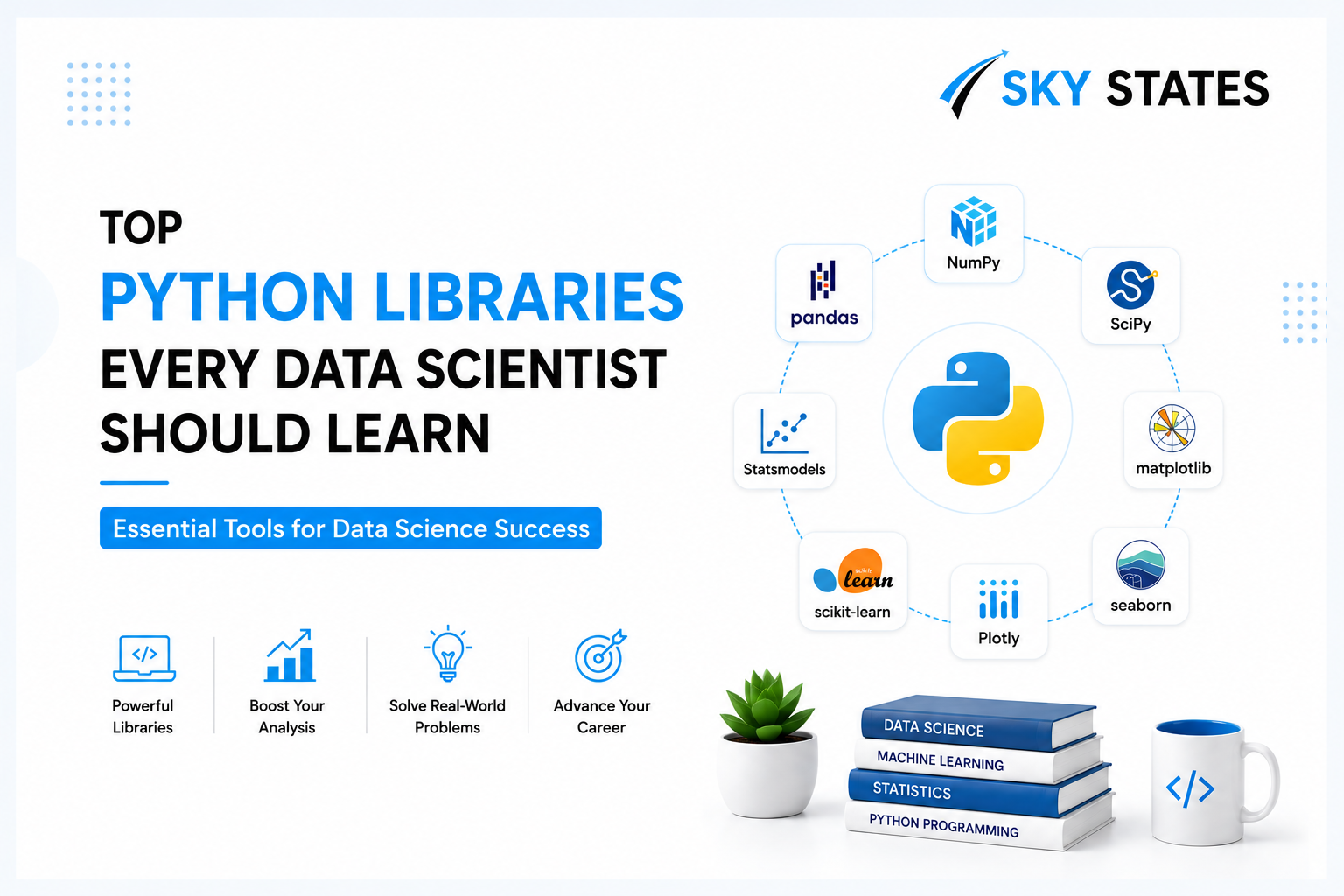
Data science integrates statistics, programming, machine learning, and data visualization to change raw information into useful perception. Among programming languages, Python has become the best choice due to its readable syntax, wide ecosystem, and broad range of tools for analyzing and modeling data. A main reason for its popularity is the availability of powerful Python libraries developed for everything from data cleaning to deep learning.
If you are a fresher or a professional, understanding the Python data science libraries can make your work process quick and more efficient. In this blog, we discover some of the best Python libraries every data scientist should know about.
What are Python Libraries?
A Python Library is a collection of already written code, functions, classes, and tools that you can use in your Python programs without writing everything from the beginning. For instance, rather than generating your own code for calculating averages, managing huge datasets, or generating charts, you can utilize an existing library like NumPy, Pandas, or Matplotlib.
Why Use Python for Data Science?
Python for data science offers an adaptable environment for managing different levels of the data science lifecycle. You can use Python to accumulate data, clean datasets, run statistical analysis, develop machine learning models, generate visualizations, and build AI applications.
Another benefit is its big ecosystem of Python packages. Libraries can be integrated within the same project, permitting data scientists to move effectively from data preparation to visualization and predictive modeling.
Best Python Libraries to Learn
Here, let’s understand the best Python libraries to learn for a brighter future. The various Python libraries given below are presented:
NumPy
NumPy is the most basic Python library for scientific computing. It offers strong assistance for multidimensional arrays, matrices, mathematical functions, statistics, and linear algebra. Many data science and machine learning tools depend on NumPy. Learning array functions, indexing, broadcasting, and basic mathematical functions is a crucial step. If you are new to numerical computing, following a NumPy tutorial can help you learn how Python manages huge numerical datasets easily.
Pandas
Pandas is important for manipulating data and analysis. It offers convenient patterns like DataFrames and Series for working with organized data. With Pandas, you can import datasets, manage missing values, filter records, integrate tables, change columns, and run exploratory analysis. It supports data sources like CSV files, Excel Spreadsheets, and databases. A Pandas tutorial should cover DataFrames, data cleaning, grouping, merging, sorting, and filtering; these functions are used in real-world projects.
Matplotlib
Matplotlib is an established visualization library in Python. It permits users to generate line charts, bar graphs, scatter plots, histograms, and other visual data. For freshers learning data visualization python, matplotlib is very useful as it offers control over chart components, labels, axes, and layouts. It is also used in Jupyter Notebook and other Python environments.
Seaborn
Seaborn builds on matplotlib and makes statistical visualization smooth. It works best with Pandas data frames and offers functions for generating statistical charts. You can utilize Seaborn for correlation heatmaps, distribution plots, box plots, categorical charts, and other exploratory visualizations. With matplotlib and seaborn, you develop a strong base for a data visualization Python workflow.
SciPy
SciPy expands Python's scientific computing features with advanced algorithms for implementation, integration, statistics, linear algebra, and differential equations. On the other hand, NumPy offers the basic numerical foundation; SciPy adds specialized scientific operations that are useful for more difficult analytical and research projects.
Scikit-learn
scikit-learn is an essential machine learning libraries for Python. It offers tools for supervised and unsupervised learning, containing classification, regression, clustering, dimensionality reduction, and model evaluation. It is useful for freshers because its API makes it easy to experiment with different algorithms and develop machine learning workflows.
TensorFlow
TensorFlow is the strongest framework for building machine learning and deep learning applications. It is useful when working with neural networks and large computational workloads. Data scientists and AI developers can use TensorFlow to build models for tasks such as image recognition, natural language processing, and predictive analytics.
PyTorch
PyTorch is a broadly used deep learning framework. It offers tools for developing and training neural networks and is known for its adaptable development experience. It is useful for researchers, AI developers, and data scientists working on advanced deep learning applications. Learning either TensorFlow or PyTorch can strengthen your knowledge of modern AI workflows.
Plotly
Plotly is useful when you need engaging visualizations. Unlike traditional static charts, Plotly can create interactive graphs that permit users to discover data via features like hovering, zooming, and filtering. It is useful for dashboards, presentations, and analytical applications where engaging data visualization Python features are valuable.
Develop Practical Data Science Skills with Sky States
Learning Python for data science becomes more effective when theory concepts are integrated with practical projects. Sky States offers a Data Science & AI program covering Python, SQL, machine learning, deep learning, NLP, data visualization, and Generative AI. The program contains live instruction, practical projects, labs, mentorship, and career guidance.
For students, beginners, and professionals who want to develop job-ready data science skills, Practical can help connect Python concepts with the real world.
Conclusion
Python gives data scientists tools for every stage of the analytical process. NumPy and pandas offer the base for numerical computing and data manipulation, while matplotlib, Seaborn, and Plotly assist visualization. scikit-learn enables machine learning, and TensorFlow and PyTorch open the door to deep learning. The goal is not knowing the names of different Python libraries, but understanding when and how to use them.
Frequently Asked Questions (FAQs):
Q1. What is a Python library?
Ans. A Python library is a collection of pre-written code that helps developers perform specific tasks efficiently.
Q2. Which Python libraries are best for data science?
Ans. NumPy, pandas, Matplotlib, Seaborn, and scikit-learn are among the best Python libraries for data science.
Q3. Is Python difficult to learn for data science?
Ans. No, Python has simple syntax and many Python data science libraries, making it beginner-friendly.
