How to Learn AI from Scratch: Complete Roadmap for Beginners
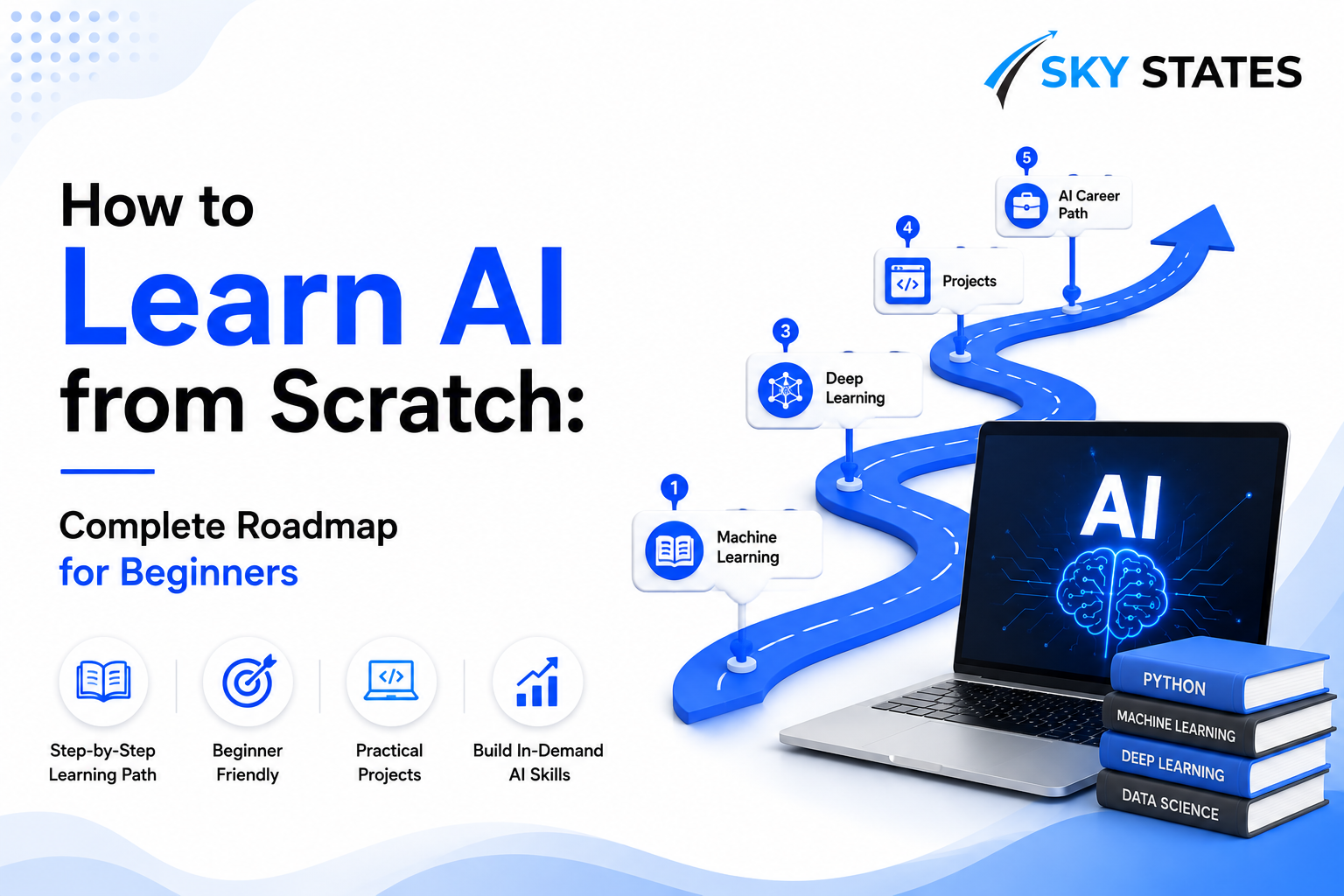
AI is changing every industry, from the healthcare sector to software development. As businesses continue using AI-powered solutions, the demand for skilled professionals is growing rapidly. If you do not know how to learn AI from the beginning, this blog offers an organized AI roadmap that helps you develop the correct skills and prepare for a successful career.
If you are a student, professional, or career changer, this AI roadmap is developed to help anyone interested in AI for beginners. The roadmap given below is based on industry learning suggested by leading educational platforms and best AI trainers.
Why learn Artificial Intelligence?
AI is no longer limited to research labs. Companies use AI for automation, analytics, virtual assistants, suggested systems, cybersecurity, and many more. Learning AI provides several advantages like:
High-salaried career opportunities
Growing demand across industries
Ability to develop intelligent applications
Futuristic technical skills
Opportunities in freelancing as well as entrepreneurship
If you follow a proper AI learning path, you can progress from basic programming to developing upgraded AI models.
Roadmap to Learn AI from the Beginning
The roadmap given below is to learn AI from the starting. You just need to follow the steps:
Step 1: Learn the Basics of AI
The first step in learning AI is knowing about the basic concepts of Artificial Intelligence. Start by learning what AI actually is, how it is different from machine learning and deep learning, and where it is used. You can even study topics like supervised and unsupervised learning, neural networks, Natural Language Processing (NLP), computer vision, generative AI, and AI ethics. Developing a powerful base will make it easy to understand advanced AI technologies in your AI learning journey.
Step 2: Learn Python Programming
Python is the most famous programming language for AI development, making it an important skill for every fresher. Begin by learning variables, loops, functions, object-oriented programming, and file management. Once you have the knowledge of the basics, discover Python libraries like NumPy, Pandas, Matplotlib, and Scikit-learn. These libraries make data analysis and machine learning tasks very simple and are widely used in every AI engineer roadmap.
Step 3: Strengthen Your Mathematics Skills
Mathematics is very important in Artificial Intelligence. You do not require advanced mathematical knowledge, but you should understand main concepts like linear algebra, probability, statistics, basic calculus, and optimization. These topics tells how AI models process data and make predictions. A strong mathematical base helps you understand algorithms rather than applying pre-built tools.
Step 4: Follow a Machine Learning Roadmap
Once you get to know Python and mathematics, start your machine learning roadmap by learning how computers find patterns in data. Study supervised learning, unsupervised learning, regression, classification, clustering, decision trees, random forests, and support vector machines. You just need to practice these concepts by developing predictive models using available datasets. Daily practical practice is the most effective way to enhance your AI skills.
Step 5: Move to Deep Learning
After mastering machine learning, continue with the deep learning roadmap. Learn how artificial neural networks work and discover advanced architectures like Convolutional Neural Networks (CNNs), Recurrent Neural Networks (RNNs), Transformers, and Large Language Models (LLMs). Also get familiar with frameworks like TensorFlow, PyTorch, and Keras, which are widely used for developing modern AI applications.
Step 6: Develop Practical AI Projects
Practical experience is as crucial as theoretical knowledge. Begin generating AI projects that solve real-world problems, like spam email detection, sentiment analysis, image classification, suggested systems, chatbots, or house price prediction. All the completed projects give strength to your portfolio and depict your ability to apply AI concepts in practical situations. Employers sometimes value practical project experience more than theoretical knowledge.
Step 7: Learn Industry Tools and Frameworks
Modern AI professionals use various development tools with programming languages. Learn Git and GitHub for version control, Jupyter Notebook and Google Colab for experimentation, Hugging Face for working with pretrained models, OpenAI APIs for generative AI applications, LangChain for AI workflows, and vector databases for Retrieval-Augmented Generation (RAG). Becoming familiar with these technologies prepares you for real AI development environments.
Step 8: Enter in AI Courses Online
A structured learning program can significantly speed up your progress. High-quality AI courses online provide organized lessons, practical assignments, quizzes, and capstone projects that reinforce your understanding. Select courses that emphasize hands-on learning rather than theory alone. Certifications from reputable learning platforms can also build your resume and enhance your career options.
Step 9: Create a Proper AI Study Plan
Success in AI depends on continuous learning rather than speed. Build an AI study plan that permits you to dedicate regular time to learning, practicing coding, and building projects. You might spend the first two months learning Python, mathematics, and AI basics, followed by machine learning in the next few months, then deep learning, generative AI, and deployment. A proper study schedule helps you stay motivated and progress toward becoming an AI expert.
Build Your AI Career Quickly with Sky States
If you are searching for expert guidance beyond self-study, Sky States can help increase your AI journey. Sky States provides technological training, practical learning experiences, and career programs that help learners develop AI and software development skills. If you are starting your AI journey or preparing for technical interviews, Sky States provides structured learning developed for today's technology landscape.
Conclusion
Learning AI might look overwhelming at first, but following a proper artificial intelligence roadmap makes the process manageable. Begin with Python, develop your mathematical base, master machine learning, advance into deep learning, and build real-world projects. You just need to stay constant with your AI learning path, complete practical exercises, and keep updating your skills as AI technologies grow.