Data Science Interview Questions and Answers: Python, SQL, Statistics & Machine Learning
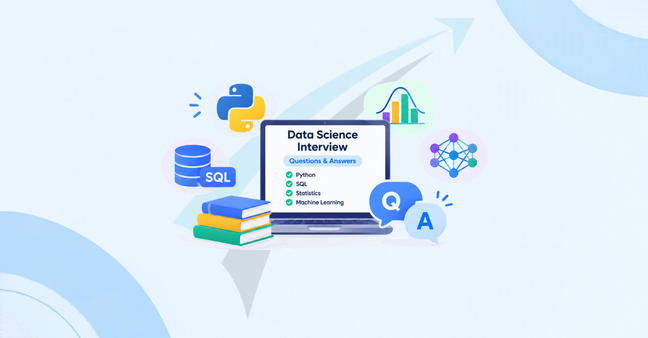
Some of the key thoughts that are included in data science interview questions are Python, SQL, statistics, probability, machine learning, data visualization, project experience and behavioral skills. Planning for these areas allows you to demonstrate your knowledge and understanding, as well as to provide other explanations and examples to help you address the practical application to problems and explain how you are deciding to deal with real business problems.
Which are the top most Data Science Interview Questions?
The bulk of interviews will focus on the following categories: statistics and probability, Python, SQL, machine learning, data visualization and business interpretation, projects and case studies, and behavioral questions.
The mix varies. Data Analyst duties could go towards SQL and dashboards. A machine learning role can be more in-depth modeling. The results you see are variable depending on seniority, employer, and format (live coding, take-home test, panel), make sure to read the job description to ensure that you are applying for the right results!
Basic Data Science Interview Questions and Answers for Beginners for easy understanding of the students.
What is Data Science?
Data science is the science of converting data to decisions by leveraging statistics, programming and domain knowledge. Consider the following example: When a retailer makes a forecast of demand, he or she considers past sales, promotions, and the nature of the season.
What is the difference between Data Science, Data Analytics and Machine Learning?
Analytics is primarily about "what" and "why. Machine Learning uses a model that learns patterns, and then makes predictions. Experiment and communication have been included within Data science, the broader category.
Distinguish between supervised learning and unsupervised learning.
Supervised learning is trained with labeled examples, for example, the email which is labeled as spam or not spam. Unsupervised learning uncovers structure, for instance in the data of customers grouped by behaviouristic traits.
What is wrong with overfitting and how can it be minimized?
Overfitting occurs when the model is too complex, memorizes the training data as well as noise, and does not work well on new data. More data, simpler models, regularization, cross validation and early stopping may be used to reduce it.
What is the difference between correlation and causation?
If two variables move together, each other's movement is correlated. If someone causes something else to change, then the one causes the other. However, ice cream sales and sunburns tend to go up together when the temperature gets warmer, but not the other way around. Causation is typically demonstrated by conducting controlled experiments.
Python for Data Science Interview Questions
The Python for Data Science set of questions are drafted to test whether you can clean and understand actual data.
For which purpose do you use a list, tuple, dictionary or set? Always use a list for ordered and changeable elements; a tuple for fixed records; dictionary for key-value retrieval; and use a set for unique elements and to test for fast checking of elements in or out.
What's the difference between NumPy and pandas? NumPy's offers fast numerical arrays. Pandas extends from it to include tables with labels (DataFrames) for cleaning, filtering, joining, and grouping.
How do you treat the missing values, and how do you get rid of the duplicate values? Investigate first. Data may be missing at random or for a specific reason. Then drop, fill or flag it, or document your choice.
python
import pandas as pd
df = pd.read_csv("customers.csv")
df = df.drop_duplicates(subset="customer_id")
df["age"] = df["age"].fillna(df["age"].median())
print(df.groupby("region")["monthly_spend"].mean())
This eliminates redundant customers, completes the missing ages with the median and prints a table of average monthly spend by region – a good initial exploratory data analysis step.
SQL for Data Science Interview Questions
SQL for Data Science question focuses on pulling and accurate pulling of the right data.
INNER JOIN vs. LEFT JOIN? INNER JOIN will return rows from both tables where there is a key relationship and there is a match between both rows. LEFT JOIN returns all rows returned by the Left table and any column on the right side that was not matched by one of the left-side rows will return a null. Write a LEFT JOIN statement to check to see if there are customers who have NOT placed an order.
How do GROUP BY and aggregates work? GROUP BY breaks the data into groups and the functions such as COUNT, SUM and AVG compute the sum for each group. Learn about using WHERE to control which rows are included in a GROUP BY, and HAVING to control which groups are included in an output.
How do you find duplicate records?
sql
SELECT email, COUNT(*) AS occurrences
FROM customers
GROUP BY email
HAVING COUNT(*) > 1;
This lists each e-mail that occurs more than once and the number of times it occurs.
What is the proper way to find the second largest salary from a list of salaries?
sql
SELECT MAX(salary) AS second_highest_salary
FROM employees
WHERE salary < (SELECT MAX(salary) FROM employees);
It looks for the highest paid salary then too it considers the maximum of what is less than that. Let it be known that window functions, such as DENSE_RANK(), can be used to solve the generalized “Nth highest” problem.
General questions on Statistics and Probability for interviews.
These are asked for by interviewers as data scientists need to determine if a pattern exists or if it is simply noise.
What is the difference between mean, median and mode? The MEAN is the average, the MEDIAN is the middle and the MODE is the one that is most common. However, for skewed data such as income in the household the median is more representative because outliers will pull the mean.
What is variance and standard deviation? Variance is a measure of the deviations from the mean. The square root of its standard deviation, expressed in the original units. It's possible for two stores with the same mean daily sale amount to be extremely inconsistent.
What is meant by conditional probability? When another event B has happened, it's the probability of event A, represented by P(A|B). Example: The probability that a customer will cancel, if they complain about support.
What does a p value mean and how does it work for AB testing? p-values represent the probability of obtaining such results or worse with no effects occurring. If the answer is small (typical, less than 0.05) this means that the difference is not most likely due to chance. It doesn't tell you what the chance is for your hypothesis to be correct, and it never provides any talk about the impact on the business. Interviewers favor candidates that also throw out sample size and effect size.
Machine Learning Interview Questions and Answers
The goal of Machine Learning Training programs is never to memorize algorithms, it's about understanding.
Regression vs. classification? Regression predicts an amount (in this case it is the revenue for the next month). Classification involves forecasting a classification, for example, whether a classification is fraud or not fraud.
What is the difference between ‘Decision Trees’ and ‘Random Forests’? A decision tree splits the data with a series of questions which makes it easy to explain but can be overfitting. Many trees trained on random samples, averaging them together tends to provide increased stability, and in general for random forest, you sacrifice interpretability for that kind of stability.
Why divide the data into training set, validation set and test set? Data information from training data fits the model, data information from validation data tunes the model, and unbiased test data is used to provide a final estimate. Data from test sections can not be reused in tuning leaks information/inflation.
Overfitting vs. underfitting? Overfit models score well on training data but poorly on new data. Underfit models are too simple and perform poorly on both.
Which evaluation metric should you use?
Accuracy works when classes are balanced, but misleads when 99% of transactions are legitimate.
Precision matters when false positives are costly, like flagging good customers as fraudsters.
Recall matters when missing a case is costly, like failing to detect a disease.
F1 score balances precision and recall when you need both.
Deeper topics such as neural networks usually come up in a Deep Learning Course or in senior interviews. For a longer learning path, see this machine learning roadmap.
A wide range of questions about data visualization and business cases are provided.
Just technical skill doesn't get you the job. Interviewers want to understand whether you can break up the analysis into a narrative form for laypeople (read finding, display one–two supporting visual displays, and visual summarizer action).
Which one is best for a business reporting scenario, Power BI or Tableau? Make a choice based on context. In many cases, the fact that Power BI is built in the Microsoft family is an advantage for teams that can already access other components, particularly Tableau's flexible visual exploratory capabilities. A solid response factors for audience, budget, history/diversion of tools and data sources. The extent of someone's need varies as per the roles, and this aspect is not the same for a data scientist. If you are looking to take a job in reporting, you might need to take Power BI Training, Tableau Training or an overall Data Visualization Course.
Data Scientist Vs. Data Analyst interview questions, what's the difference?
Reporting, dashboards, SQL, and business interpretation are often highlighted in analyst interviews. Statistics, experiment, predictive models, and machine learning are further areas of expertise that are commonly included in data scientist job interviews. These are guidelines, not regulations. You're not entirely sure what to do: tasks are overlapping, and the job description will take you through what to do. A Data Analytics Course is a sensible choice if you're starting from the foundations of data analytics.
Using Percentage When Answering Behavioral Questions in a Data Science Interview
To use the STAR approach to answer: Situation (context), Task (your responsibility), Action (what you did), Result (what happened).
Situation: We had an issue where sales data just continued to pour in without any uniting criteria behind them, so this happened to be a revenue spike. Task: We were asked to verify this before a meeting with leadership. Action: I traced out what caused the sudden surge in revenue, discovered it was due to an environment change to a pipeline, wrote a query to isolate the records, and reported the problem to the data engineering team. Result: This corrected dash went out, and duck in the pipeline is implemented as a future workaround.
Use “I” with reference to your work, and “we” in connection with team work. Even if this is not from a job, look at what work you did in school, personal, or portfolio projects. In an interview, interviewers are interested in your rationale, not your job title.
A guide for preparing for practical interviews in Data Science.
This is a suggested 14 day programme. The amount of time you will need and the types of roles you go for – you may need more or less on that – and this doesn't guarantee that you'll get an interview. If you're looking for a bigger picture, check out this data science roadmap.
Days 1-2: Review statistics and probability.
Days 3–4: Work Practice Python & pandas.
Days 5-6 – Answer SQL Questions!
Days 7-9: refresh ML fundamentals and its evaluation metrics.
Day 10–11: write a Project explanation and Case study.
Days 12 – 13: Practise Behaviorism answers and timed technical questions.
Day 14: Practice an interview and discuss areas of weakness.
The skills imparted from Structured Data Science Training can be very useful for the interviews.
For many people, self-study is a good option. If a clear sequence of data science training, guided practice with the data, feedback on projects and a mock data science interview is desired, consider using Structured Data Science Training.
The SkyStates Data Science & AI program is a 6-month, in-residence, online course. It is not running any new courses; the following courses are listed in its curriculum: Python, NumPy, pandas, statistics and probability, supervised and unsupervised machine learning, deep learning, MySQL, Tableau, Power BI, capstone projects. It also has mentorship, portfolio support, mock technical and HR interviews. The course description on the program page indicates prerequisite knowledge of basic Python and that tuition will cover one sitting of the Microsoft DP-900 (Azure Data Fundamentals) exam. Verify information, schedule and rates prior to enrollment.
Before deciding on the Best data science & ai course in Washington, check out the curriculum, practical projects they offer, mentorship, interview preparation, schedule and fees. If you are looking at an Online Data Science Course, our guide to what a data science course entails and what possible career routes it can lead to will help you assess any course you're considering. Any program doesn't provide any guarantee in a job, salary, or the result of an interview.
Data Science Interview Questions on Project. Data Science Project Based Interview Questions.
Projects are the place where you demonstrate your ability to do the job. Organise your explanation in the following ways:
Business problem addressed: What was the business decision that was being made?
The data: Source and Size problems and Quality problems.
Methods and Tools: What were your attempts and your reasons.
Your contribution: (What you personally did and particularly in the team work).
Data: Measures and their interpretations.
Limitations and lessons learned: things you would change.
You might say it is with regard to a customer churn project, I analysed a data that had a small sample size and a telecom company that did not have any section of real-time testing of their campaigns; about a quarter of the information lacked contract details, so I filled out their missing contract data and set out flags; I tested logistic regression against a random forest model and have prioritised recall, if I miss out a churner is more expensive to the business than a wasted retention offer. The major limitation with the project is that it is a small dataset with this and the fact that there was no campaign testing at all.
Be truthful about scope and never claim a class or personal project as work experience. Relevant Machine learning projects found on GitHub provide a solid basis for discussion to interviewers.
Compare and contrast with Related Technology Learning Paths at SkyStates
These are not required courses for data science interviews; and they are not necessarily equal courses.
Agentic AI and Generative AI: Talented at building AI applications, particularly AI Agents, RAG and generative AI, consider the Agentic AI and Generative AI program.
Deployment and Cloud – If you wish to pursue deployment, cloud infrastructure, automation and production environments, then the DevOps and Cloud Computing program.
Security: If you're interested in security operations and threat analysis and preserving the security of digital systems, take a look at the Cyber Security training program.
Frequently Asked Questions About Data Science Interview Questions
What to say to interview questions that make use of behavioural analysis criteria?
Try the STAR and two-minute guideline and make it specific when it comes to what you did. Choose stories related to issues with data quality, vague requirements or communicating results to non-technical people and conclude with the result and learnings.
What are the most commonly tested topics in statistics and probability?
Descriptive statistics, distributions (particularly normal), conditional probability, Bayes' Theorem, hypothesis testing, confidence intervals, p-values and A/B testing. Be prepared to provide examples of each using a business context, not just with the formula.
What machine learning algorithms should I review before a data science interview?
Review linear and logistic regression, decision trees, random forests, gradient boosting, k-nearest neighbors, k-means clustering, and the basics of PCA. For each, know when it fits, its main assumptions, and how you would evaluate it.
How do I prepare for a data science case study or take-home test?
Restate the business question, check data quality, build a simple baseline before complex models, and choose metrics tied to the business goal. Document your assumptions, explain limitations, and present a clear recommendation. Respect any time limit rather than over-polishing.
Which coding problems (Python/SQL) are common in data science interviews?
In Python, expect string and list manipulation, dictionary counting, and pandas tasks like filtering, grouping, merging, and handling missing values. In SQL, expect joins, aggregations, duplicate detection, window functions, and “Nth highest” problems.
Final Thoughts
Strong preparation comes down to solid fundamentals, hands-on Python and SQL practice, statistics you can explain in plain language, machine learning concepts tied to the right metrics, project stories you can defend honestly, and clear communication. Practice out loud, because explaining your reasoning is half the interview.
If you’d like structured learning and guided preparation, explore the SkyStates Data Science & AI program. You can also read student feedback and experiences on SkyReviews, keeping in mind that individual experiences vary.