Data Science Roadmap 2026: Skills, Tools & Career Path
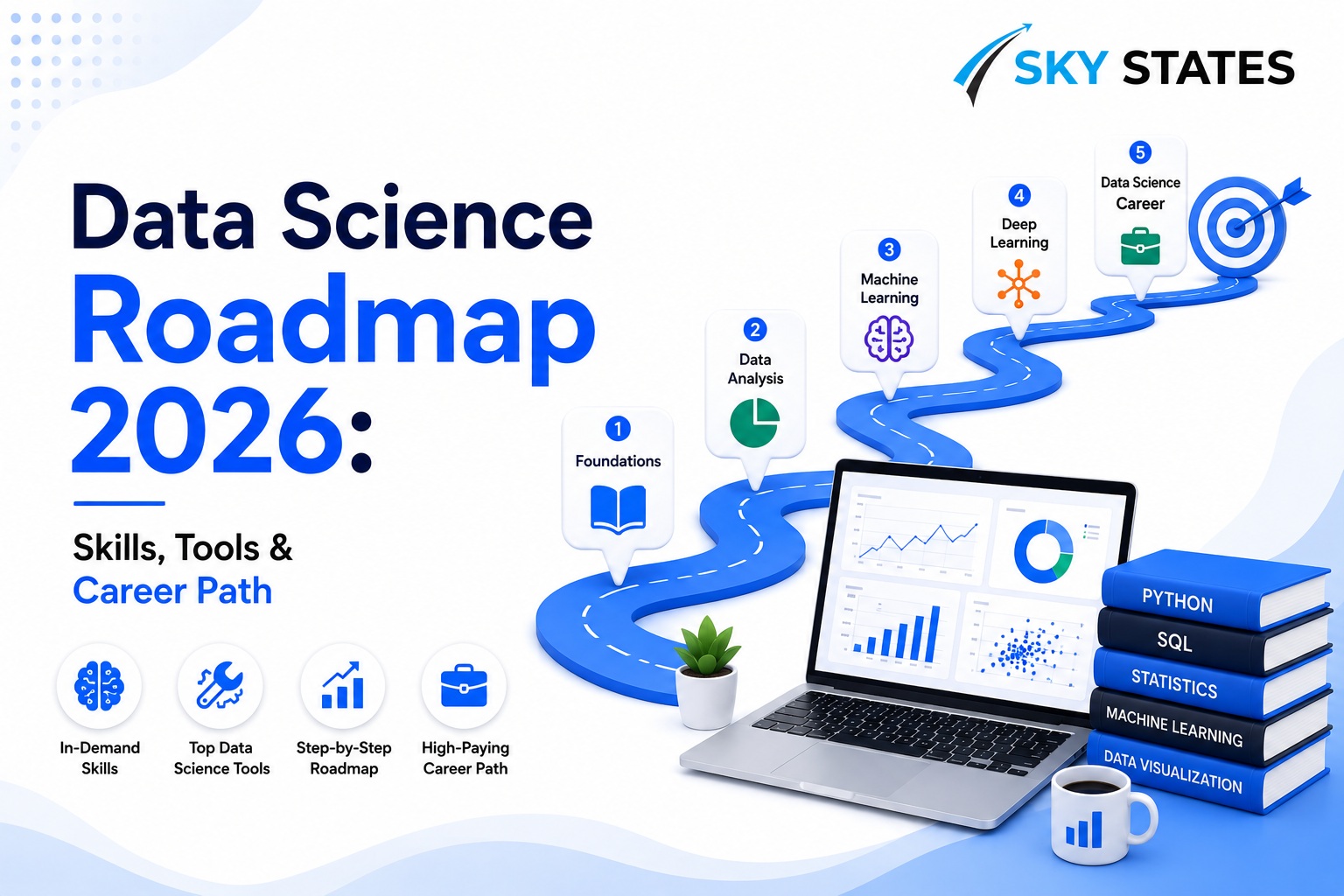
Data is making decisions in every industry, from finance to technology. As businesses rapidly adopt AI and Machine Learning, the demand for experts who can change raw data into actionable understanding continues to grow. If you are planning to learn data science in the year 2026, having an organized roadmap can help you concentrate on the correct skills, projects, and tools.
This data science roadmap outlines the important levels a fresher should follow to learn machine learning and AI.
What is Data Science?
Data science integrates programming, statistics, mathematics, analytics, and machine learning to extract meaningful insights from data. A data scientist may gather and clean data, find patterns, develop predictive models, and communicate findings to business teams.
In 2026, the field is increasingly connected with AI, cloud platforms, automation, and generative AI. Therefore, modern data science skills go beyond traditional analytics and contain practical knowledge of machine learning, visualization, databases, and AI technologies.
Data Science Roadmap 2026
Here, as given below, let’s discuss the roadmap for your smooth career in data science. Let’s see:
Develop a base in Mathematics and Statistics
Begin by understanding the mathematical concepts that are used to analyze data and develop models. You should learn descriptive statistics, probability, distributions, correlation, regression, hypothesis testing, and linear algebra. You do not need high-level knowledge of mathematics in the beginning. Try to concentrate on understanding how these concepts are applied to real-world datasets and machine learning models.
Learn Python for Data Science
Programming is an important part of a modern data scientist roadmap, and Python is a widely used language in the field. Begin with variables, data types, conditional statements, loops, functions, lists, dictionaries, and object-oriented programming. Then move into libraries like NumPy and Pandas. Python for data science permits you to clean datasets, automate repetitive tasks, perform analysis, visualize details, and organize data for machine learning.
SQL for Data Science
Sometimes Data is gathered in relational databases, making SQL an essential skill for data experts. Your SQL for data science learning should contain SELECT statements, filtering, sorting, aggregation, joins, subqueries, CTEs, and window functions. Powerful SQL knowledge permits you to retrieve and change the data needed for analysis and modeling without depending completely on other teams.
Know Data Analytics and Visualization
Before developing difficult predictive models, learn how to understand and communicate data. Data analytics involves examining datasets to find trends, patterns, relationships, and business opportunities. Learn about tools like Pandas, NumPy, Matplotlib, and visualization platforms such as Power BI or Tableau. Generating dashboards and clear visualizations is particularly valuable because technical findings must be presented to non-technical audiences.
Follow Machine Learning Roadmap
Machine learning is an important level in the data science career roadmap. Start with learning concepts like linear regression, logistic regression, decision trees, and random forests. Then discover unsupervised learning, containing clustering and dimensionality limitation. Learn how to divide datasets into training and testing sets and evaluate models using appropriate metrics like accuracy, precision, recall, F1-score, and RMSE. When these basics are clear, you can learn advanced areas such as ensemble learning, NLP, deep learning, and generative AI.
Learn Important Data Science Tools
A complete data professional needs more than programming knowledge. Common data science tools include Jupyter Notebook, Git, GitHub, Pandas, NumPy, Scikit-learn, TensorFlow or PyTorch, Power BI, Tableau, and cloud platforms. You should also become familiar with Docker, APIs, and basic cloud services as you progress. These technologies help you move from experimentation to production.
Choose the Correct AI and Data Science Course
Self-learning can work, but an organized data science course can offer a proper curriculum, assignments, guidance, and career preparation.
For learners searching for an industry-focused option, the Sky States Data Science & AI Program provides a six-month online learning program covering Python, machine learning, deep learning, SQL, Power BI, Tableau, AI, MLOps, and project-based learning. The program also contains live sessions, practical labs, capstone projects, mentorship, and career guidance.
Conclusion
A complete data science roadmap is not about learning every tool available. It is about learning the correct concepts in the right sequence. Begin with mathematics, statistics, Python, and SQL. Move into analytics and visualization, then learn machine learning and AI. Finally, develop practical projects and build a professional portfolio.
