Why Most AI Agent Pilots Stall Before Production (And How to Fix the Workflow)
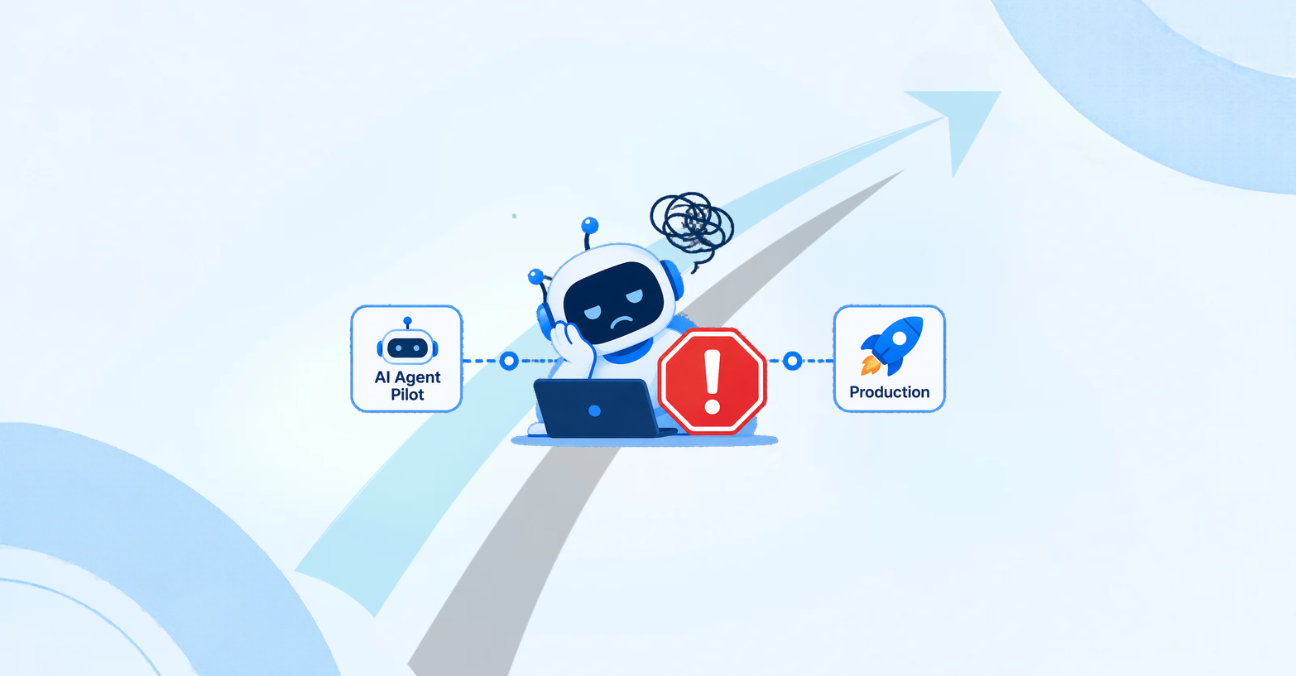
Even if an agent performs well, there is often insufficient thought as to how it can be reconfigured for production. Data and ownership can also be problematic. Furthermore, limited consideration is often given to how an agent can be managed if it is found to incorrectly perform a function. Good integration of an agent into a process and setting of KPIs and sign off points can then allow it to be moved into production, provided the right data is available.
Why AI Agent Pilots Lose Momentum
Whilst often quickly developed and piloted, building on a good test result, a management team may seek to do this. Yet, agents often do not receive adequate support. Although an agent can effectively perform straightforward functions, it can typically find more advanced functions harder. Ownership is also often unclear and agents frequently become ‘pet’ projects.
Generally, agents are not to blame. Modern language models are remarkably effective and can perform various tasks such as triage, report generation and data retrieval. However, problems can arise within an agent’s surroundings. Processes, systems and people can all influence the trust that is placed in agents. Within a pilot the potential of an agent is explored. Good and largely self regulating performance for the relevant function is crucial in re-configuring an agent for production.
Understanding this is integral to understanding why so many new and innovative projects remain at pilot stage. As previously highlighted, this again relates to processes and not technology.
Five Reasons AI Agent Pilots Stall
1. The Workflow Was Never Redesigned
Whilst still largely performed by hand, processes are often then applied to an agent. We usually understand which of our clients requires more focused attention and which spreadsheet columns are most prone to errors. Unfortunately agents do not and so will often experience difficulty within precisely the areas that humans are least knowledgeable about – unless this information is documented.
2. Data and Tool Access Break Outside the Demo
Whilst good and easily available data is often used during a pilot, data processing tends to be slower in production. Data can also be incorrect and duplicated. Moreover, APIs can become outdated. Unfortunately it is often hard to determine whether and when an agent has utilised unsuitable data and/or systems even though, typically, we are largely confident that this has not occurred.
3. Nobody Defined What "Good" Looks Like
Whilst many projects are influenced by people’s beliefs regarding good quality, there is often no clear understanding of what this entails. For example, in respect of accuracy. Often there is also no understanding of how much inaccuracy can be tolerated. Similarly, cost awareness is commonly limited. Without test data and KPIs it is impossible to illustrate value generation and to evaluate an appropriate fit for production. Consequently sign off is often continually deferred.
4. Humans Are Missing From the Loop
Whilst individuals are often concerned that agents will not be adequately governed, they should be. Typically no production roll-out can occur without sign off and a escalation route. Agents are commonly formally rolled out.
5. Operations Are an Afterthought
As well as data recording, investigation and versioning, there should also be someone who can recognise and resolve issues. None of these are implemented for notebook pilots. Retro-fitting can be expensive and is often the reason for the termination of many projects.
Pilot vs Production: What Actually Changes
Use the table below to compare your project in respect of:
How to Fix the Workflow Step by Step
Start With the Process, Not the Agent
Outline your process on one page. Identify inputs, output and decision points. Evaluate what can be automated and then allocate this to an agent. Individuals must continue to be involved in decision making, unless enough data can be obtained to facilitate change here.
Shrink the Scope and Pick One Metric
Identify which elements can be handled by an agent. For example clients’ enquires can be grouped and contracts analysed. Select one primary KPI, for example, accuracy. This can be analysed using 100 real life and tagged examples. Likewise, identify one cost KPI. Controlling a project’s scope allows value generation to be illustrated on a weekly basis (rather than quarterly).
Build an Evaluation Set Before You Scale
As well as good quality data, also create low quality live data. For each of these, identify the anticipated result. Continually test an agent using this data following any changes to prompts, modelling and/or systems. This easily identifies regression. Stake-holders also benefit from having access to objective data.
Design the Human Checkpoints
Decide which agent functions can be automated and which can be sign offed. Some functions should never be carried out by humans. Typically, lower risk functions such as data tagging can be automatically performed. However, higher risk functions for example, refund provision, external communication and database amendments, should generally be initially sign offed by humans. As confidence in an agent increases, so should the tolerance for sign off.
Treat Deployment Like Any Other Software Release
Package an agent and its prompts and settings. Apply version control. Monitor system usage and control costs. Individuals with strong DevOps and cloud skills can considerably more rapidly roll out agents as they are already experienced in CI/CD, monitoring and back tracking.
Choosing the Right Approach: Automation, Single Agent, or Multi-Agent
Whilst agents can be very advantageous, not all issues can effectively be dealt with using them. As discussed above, high complexity is also often a cause of project failure. Generally speaking the more elements that are included, the greater the potential for problems to occur.
Typically basic functionality should initially be rolled out. Additional functionality can then be incorporated into agents in respect of areas where specific and distinct requirements cannot be met by basic functionality.
Skills Students and Professionals Need to Ship AI Agents
Whilst there are enough people to formulate clever and efficient prompts, frequently there is a paucity of people who can roll out agents and ensure that they are consistently rolled out. Employers are currently seeking to appoint people with improved knowledge in areas such as retrieval, tool calling and agent roll out. Such knowledge is not usually attainable through tutorial provision.
Professionals can also reap benefits. Software engineers, data analysts and/or cloud administrators are likely to already have substantial knowledge in the aforementioned area particularly concerning API and data and infrastructure. Further development of an individual’s profile can be achieved by pairing this with well designed agents.
An organised way exists whereby you can learn. As well as completing 10+ projects and a capstone within Sky States’ Agentic AI & Generative AI programme, you explore RAG, AI memory, LangGraph, CrewAI, AutoGen and tool calling. Career routes are detailed on SkyReviews and display good logical progression. Furthermore, there is a technical glossary to further explain terms such as RAG, embeddings and tool calling. Common AI interview questions can also be practised within the interview section so that people can effectively prepare for a real interview.
Frequently Asked Questions
Why do so many AI agent projects fail to reach production?
Whilst rarely is the model at fault, ill-defined notions of success, poor data and inadequate individual engagement and governance are often reasons for project failure. Importantly, beyond visualisation, agents seldom have robust evidence to underpin the reliability of their output.
How long should an AI agent pilot last?
Around 4 - 8 weeks is appropriate for a highly specialised agent. Beyond this timeframe agents tend to experience drift. It is therefore important to pre-define when a pilot should end so that a project team can then determine when to roll out, amend and/or duplicate an agent’s functionality.
What should I measure in an AI agent pilot?
Investigation of accuracy, unit cost, time efficiency and individual/system interaction can all contribute towards determining whether or not an agent should fully be rolled out.
Do I need to code to work on AI agents?
Whilst not always, product managers, analysts and operations heads all influence and investigate processes and success measures. Yet as previously outlined, software engineers require knowledge of Python, API’s and cloud in order to design and roll out agents.
Is a fully autonomous agent a realistic goal?
Currently, for the majority of business related functions this is not possible. Gradually, build an agent’s ability to carry out more high risk functions. As trust in an agent grows further functions can then be added to those that it is already capable of. Although motivation is an important consideration, initial levels of autonomy should not be allocated to agents.
Conclusion
Generally, AI agent projects do not fail for technology related reasons. However, processes and practice are often inadequately prepared for production. Clearly and flexibly define an agent’s functionality and appropriately pilot it. Ensure adequate individual engagement and roll out agents, broadly speaking, in a similar manner to other software. An agent can thus transition from being purely for display to becoming a strong operational element. Process knowledge is fundamental to both students and professionals wishing to be successful in AI career routes.