The Anatomy of a Ransomware Attack: From Initial Access to Data Recovery
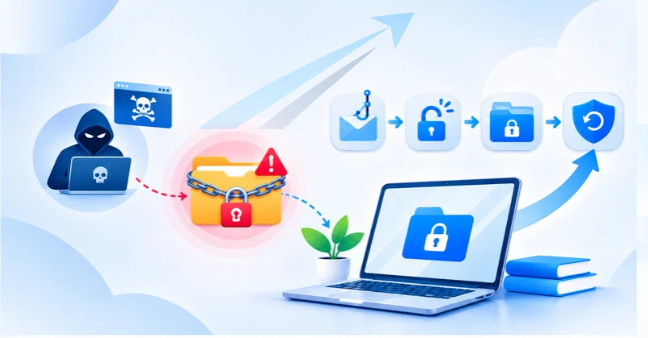
The Ransomware Attack Lifecycle outlines how a ransomware adversary would gain access to an organization, infect the system to gain persistence, move horizontally and eventually gain access to critical business data for encryption or exfiltration. It's important to remember this process if you'll be joining a US cybersecurity team or having to develop and execute an IT plan, given that cyber threats now happen in a methodical, human way. By examining the life cycle of ransomware usage attacks, from initial access, through payload execution, to data recovery, security teams can seize on important detection points before payloads can do irreparable damage.
What Is the Ransomware Attack Lifecycle?
The ransomware attack lifecycle outlines the progression of ransomware incidents or targeted attacks in enterprise networks. Days or weeks are spent by threat actors to map the internal infrastructure, outsmart the security measures and attack backups.
Some of these events are immersed in five general phases and operational models divide the activity into seven phases. Understanding these ransomware attack stages will enable organizations to move from firefighting to proactively looking for threats.
Understanding the Seven Stages of a Ransomware Attack

Stage 1 – Initial Access
Hackers trick users into opening links, sending bogus messages or log in using a known username and password, exploit software vulnerabilities, or exploit leaked RDP gateways.
Scenario: Attacker's goal is to target a Chicago business with the objective of stealing personal information via a phishing email that appears to be an invoice.
Early Indicators: Logon from unusual locations, and failed attempts at logon, such as having a burst of logon sessions on a remote computer.
Stage 2 – Execution and Establishing Persistence
When adversaries change credentials they run scripts to stay connected, and use administrative tools, such as PowerShell or WMI, to get access when they're not detected.
Detection: Blocking of unwanted PowerShell execution, and scheduled task monitoring.
Stage 3 – Privilege Escalation and Credential Access
Using credential-dumping tools such as Mimikatz or exploiting misconfigurations of permissions, attackers advance the privileges of normal user accounts to domain administrator-level privileges. Attackers then use credential-dumping tools like Mimikatz, or even permission misconfigurations, to upgrade the permissions of normal user accounts to those of a domain administrator.
Mitigation: Least privilege access, audit and monitoring privileged accounts on a constant basis.
Stage 4 – Discovery and Lateral Movement
Stealthy attacks start on workstations and gradually transfer to the core equipment and network infrastructure, such as databases, RDP/SMB vulnerable servers etc. using Active Directory recon and such protocols.
Warning Signs: Suspicious connections within the computer and access to shared files.
Stage 5 – Data Collection and Exfiltration
The attackers will find sensitive files in the double extortion attack and ex filtr them before the encryption.
Risk: Regardless of backup activity, risk is posed as a result of data theft—there are both operational and regulatory risks involved.
Stage 6 – Ransomware Deployment and Encryption
Once the actors have been identified, the adversaries launch the ransomware payload, starting to encrypt data, interrupt the server's functioning, eliminate EDR agents and remove snapshots from local backup files.
Stage 7 – Detection, Incident Response, and Recovery
Segregated infected network segments, maintained logs, cleaned up attackers' access points, re-reset credentials and recovered clean backups. If the files are kept from being removed on reinfection, the files can still be restored.
Ransomware Attack Lifecycle Example: How an Attack Can Unfold in a Business
What Are the Early Warning Signs of a Ransomware Attack?
Discuss these important behavioural clues:
Creation of administrator Accounts outside of office hours.
Suspicious command pair's arguments and encoded PowerShell.
Unusual traffic in and out of the network going to unknown IP addresses.
Some security tools/Logging service crashed unexpectedly.
Elevated "Ransom Notes" and/or file extensions that change quickly over time.
Ransomware Detection Techniques at Different Attack Stages

Loosely coupled tiers thwart attacks at the source:
EDR/XDR: Identify credential being dumped, process being executed.
SIEM/Log Aggregation: Do cross-platform correlation of authentication anomalies. Using methods from Data Science & AI Program can improve the use of pattern recognition and machine learning in the analysis of anomalies by security analysts.
Network Traffic Analysis (NTA): Identify internal reconnaissance/transmission and exfiltration.
Threat Hunting: Proactively Search for Hidden Persistence - Threat Hunting.
How to Prevent and Mitigate a Ransomware Attack
The key controls to be effective against enterprise ransomware are:
Implement and enforce phishing resistant multi-factor authentication (MFA).
Continue patching of edge devices and systems.Continue edge device/patching and systems patching.
Implement network segmentation to prevent lateral movement and access through DevOps & Cloud Computing Program infrastructure and container worlds.
Enforce "least-privilege" access to everything on all accounts.
Practical Cybersecurity and Pen Test skills enable teams to narrow down gaps early on and AI-powered Cyber Security training assists in efficiently detecting threats and automating the triage process.
 The 3-2-1 Backup Rule and Ransomware Recovery
There are several reasons why, if backed up appropriately, backups should be an essential precaution against any future destructive attack involving encryption:
3 Copies: Store 3 copies of extremely important business information.
2 Media Types: means that data is stored in a pair of two we have, whose content is different.
1 Offsite/Offline Copy: Store one copy that is kept physically offsite, and cannot be changed without losing it.
Ransomware Incident Response: What Should Organizations Do?

During an incident do the following:
Isolate: Shut down impacted machines as soon as possible without interrupting power so that they can be used for memory forensics.
Preserve Evidence: Keep syslogs and memory dumps.
Eradicate: Close the access points, change the credentials and remove any persistence.
Restore: Implement automated workflows for backups to rebuild systems, and maintain monitoring, all provided in the Agentic AI Program.
Ransomware Attack Lifecycle vs. MITRE ATT&CK
The ransomware lifecycle outlines a series of time-based events, while MITRE ATT&CK groups up tactics that adversaries use in an incident. By matching stages with MITRE techniques, security teams can leverage their knowledge of hands-on adversary techniques to validate detection rules in the real-world.
Is Ransomware Still a Threat in 2026?
Ransomware is continuing to be a major threat to US businesses operations. Modern threat groups remain well on their way to further evolution of HOW attacks, weaponization of cloud resources, and ramping up extortion efforts. Monitoring and subsequent resilience planning for incidents, or other events, is still vital for the survival of enterprise.
Building Skills to Understand and Defend Against Modern Cyber Threats
There is a need to be continually educated and "hands-on" in the battle against multi-stage attacks. Knowing what is happening on infrastructure, understanding threats and being able to use automated techniques for detection are essential skills for security teams. For a more in-depth look at training tracks or check out actual technology professionals' stories through Sky Reviews.
Frequently Asked Questions
Q1. What are the five stages of a ransomware attack?
Ransomware attacks can be broken down into five phases: initial access, execution, persistence/lateral movement, data exfiltration, and encryption/impact.
Q2. What is the 3/2/1 rule for ransomware?
As per the rule of 3-2-1, you should have 3 copies in total and at least 2 copies should be stored on different types of media (physical) and at least 1 copy kept off-site and unchangeable or unreadable.
Q3. What are the seven stages of a ransomware attack?
The seven phases are the initial access, execution/persistence, escalation of privileges, discovery/lateral movement, data exfiltration, data encryption, and detection, incident response, and data recovery.
Q4. Is ransomware still a threat in 2026?
Yes. More than ever before, ransomware continues to be a primary attack strategy employed by human-operated campaigns, ransomware variants using double extortion or by targeting cloud infrastructure or remote access infrastructure.
Conclusion
Because of poor visibility during the initial stages of planning a ransomware attack, they are successful. To stop attackers in their tracks by understanding the ransomware attack lifecycle and ensuring strong preventative measures are in place, organisations should have good recovery processes in place. Constantly improving your knowledge and defence techniques will keep your enterprise secure.