RAG in Cybersecurity (2027): Building a Threat Intelligence Assistant for SOC Teams
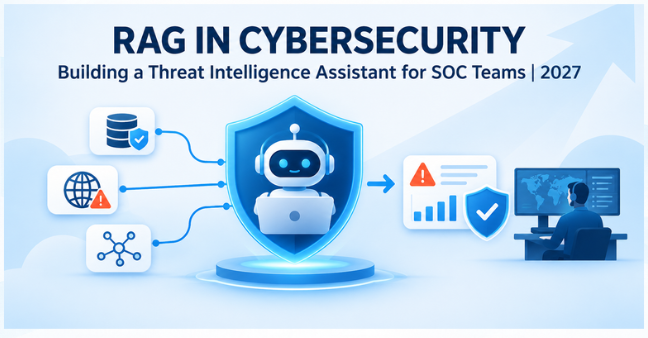
Within cybersecurity, RAG can be used to access external sources to enhance the SOC. By 2027, RAG can be used to provide referenced intelligence from external sources (threat intelligence, vulnerabilities, runbooks, etc.) to the SOC. As queries are performed, relevant pieces of intelligence will be accessed from the vector store and included in the prompts to the LLM. This provides an audit assistant to SOC teams with fragmented security intelligence, alerts and playbooks.
In 2027 for AI threat intelligence assistants to be implemented in buildings with chat capabilities, structured systems engineering methods must be followed. In Harbinger 6, workflows can be exposed to ungrounded results, untrusted feeds or both.
What Is RAG in Cybersecurity?
By separating knowledge from language generation, RAG can be utilised in cybersecurity. In instances that an ASN, process or domain is suspected, the information can be put into a secure knowledge base. From here sentences can be generated, allowing the LLM to produce an answer.
Timely Threat Context: Unlike base models, regular updates to the RAG indexes will occur so that new advisories can be added.
Internal Visibility: If the LLM is not privately indexed, it will not have access to internal layers, networks and custom runbooks.
Source Traceability: As information is added to the prompts, metadata in the form of sources is added. This means the correct way to reference the document can be determined.
Why Traditional Threat Intelligence Analysis Needs an Upgrade in 2027
Although tools such as SIEMs, TIPs and EDR can quickly and accurately complete deterministic searches (known hashes, IPs and/or YARA rules), once an alert has been raised a significant amount of time is spent by analysts going through irrelevant portals, historic tickets, and long complex threats.
In October, many vendors have commented that a lot of contextual information has been missed in relevant searches using keywords. RAG addresses this issue and improves SOC processes. By using natural language queries, information can be obtained from threat reports, advisories and post-mortems.
How a RAG-Powered Threat Intelligence Assistant Works
5 Steps to Create AI Threat Intelligence Pipeline
1. Collecting Threat Intelligence Sources
Sources of threat intelligence collected. Sources of trusted threat intelligence are chosen. This includes CISA Advisory, NVD, STIX/TAXII Feeds, MITRE ATLAS, MITRE ATT&CK, and runbooks from SOCs.
2. Data Processing and Knowledge Indexing
Analysing data and creating a secure knowledge base. Text, metadata (date, TLP, CVE ID, ATT&CK techniques) and chunked text (300-800 Tokens with overlap) is extracted from the pipelines.
3. Embeddings and Vector Database Integration
From multiple user inputs, embeddings will be made. In Cybersecurity vector databases can be locally hosted (FAISS, Chroma, Milvus) or enterprise scalable (Pinecone, Weaviate, Milvus).
4. Context Retrieval and LLM Response Generation
Relevant context is found and responses from the LLM produced. A hybrid search algorithm combining vector similarity and BM25 will be applied to the query to obtain precise IOCs. The top chunks of information will be placed into prompts for the LLM, with emphasis on citations. Hybrid search was designed to take advantage of semantic similarity, while also maintaining precise IOCs. Top chunks of information will be placed in a citation limited prompt for LLMs.
5. Analyst Verification and Investigation
A grounded summary can be generated. Results can be passed to SOC analysts for verification and approval. Understand social engineering to investigate suspicious domains. Large scale investigation of suspicious URLs using RAG.
Illustrative Example: Investigating a Suspicious Domain Using RAG
Note: This example is based on principles of engineering and not data. Therefore, this example is not verified nor a case study on customer success.
Example: A Tier-1 analyst receives an alert on their SIEM. 3 endpoints are requesting a DNS address of “cdn-auth-update[.]net” and an encoded PowerShell process. To gain further intelligence, the analyst requests information using the RAG assistant.
Traditional Threat Intelligence vs. General AI Chatbots vs. RAG
Whilst RAG may not be more accurate than deterministic systems (IOC lookup in SIEMS can be very accurate for known IOCs), RAG can provide more context from multiple data sources.
Security Risks of RAG-Based Cybersecurity Applications
Refer to OWASP Top 10 for Large Language Model Applications.
Prompt Injection: Instructions within contents of feeds can cause an attack. Mitigation: Sanitisation, split on delimiter, no autonomous writing.
Data Poisoning: Biases in information from untrusted data sources can be mitigated by using validated data sources with signatures. Scoring systems can be applied to feeds.
Sensitive Information Disclosure: Information may be exposed in logs and PII. To limit this risk, redaction should occur before embedding, and private VPC inference should be used.
Unauthorized Knowledge Access: Access to documents is not controlled in vector stores. RBAC should be applied alongside filtered metadata per user.
Technologies and Skills for AI-Driven Security in 2027
Reliable assistants will be able to generate Python scripts, embeddings, vector databases (FAISS, Chroma, Pinecone, Weaviate, Milvus), Scripts to utilise LangChain/LangGraph, Integration with cloud providers (AWS, Azure, GCP), Integration with SIEM/SOAR, and Docker by 2027.
Before automated SOC processes can be created, some basic understanding of security concepts (and ethical hacking concepts) must be understood. This includes log triage, network analysis, and threat modelling.
In some cases when enterprises make multi-step tool calls and stateful orchestrations, they may use agentic AI, automated programs, and machine learning capabilities.
Data Scientists and AI Engineers may be interested in creating statistical models, NLP, and evaluation processes.
DevOps and cloud computing can be useful for secure deployment of cloud infrastructure. This can significantly aid deployment of vector stores and inference services.
Sky States LLC offer a live, taught course called the Cybersecurity with AI Professional Program. The course includes Python automation, Machine Learning threat detection, RAG threat intelligence assistants, LangGraph SOC processes, OWASP LLM security, and 10+ case studies.
Learners can gain insight from student feedback in Sky States Reviews to make decisions on program outcomes.
Frequently Asked Questions
1. What is RAG in cybersecurity?
RAG in Cybersecurity involves integrating an LLM with a secure indexed database of security related data (threat feeds, CVE advisories, internal runbooks and MITRE ATT&CK).
2. How can RAG help SOC analysts?
RAG allows for quick investigations by putting all previous context relating to the incident, attackers TTPs, and/or internal playbooks into a single referenced summary. RAG reduces manual navigation between tools by quickly placing all information from past incidents, attackers TTPs and/or internal playbooks into a concise, referenced summary.
3. Which vector databases are used in cybersecurity RAG applications?
Typically, teams use FAISS for local/lab environments, and Chroma for scalable production environments with filtering. Most teams choose to use either FAISS for local/lab environments, or one of Pinecone, Weaviate, or Milvus for scalable production environments with filtering capabilities.
4. Can RAG replace cybersecurity analysts?
No. RAG assistants do not replace human analysts. They simply assist human analysts in gaining evidence approval, impact approval and containment approval.
5. What skills are required to build AI threat intelligence assistants?
A wide range of skills should be developed, including Cybersecurity, Python, embeddings, vector databases, LLM orchestration (LangChain/LangGraph), OWASP LLM security, and cloud deployment.
6. Where can professionals learn AI-driven cybersecurity?
Sky States LLC offer a live, taught course in Cybersecurity with AI. It includes 10+ hands on projects, Mentoring, and a capstone project including RAG threat intelligence assistants & LLM security. This is a great value for professionals wanting to master Cybersecurity, with the power of AI.
Conclusion: The Future of Threat Intelligence in 2027 Is AI-Assisted
As threat volumes increase, manual triage is at risk. Un-grounded generative AI poses clear operational risks. In cybersecurity, RAG improves LLM summarisation by providing accurate verified intelligence as a foundation, with human oversight and internal runbooks to speed up and improve accuracy.
Proficiency in Python, vector databases, langgraph processes and LLM security will allow practitioners to overcome future security challenges in 2027. Find out more about the content, hands on projects and style of learning on the Sky States Cybersecurity with AI Professional Program.