LLMOps (Large Language Model Operations): The Bridge Between Data Science and Cloud Infrastructure
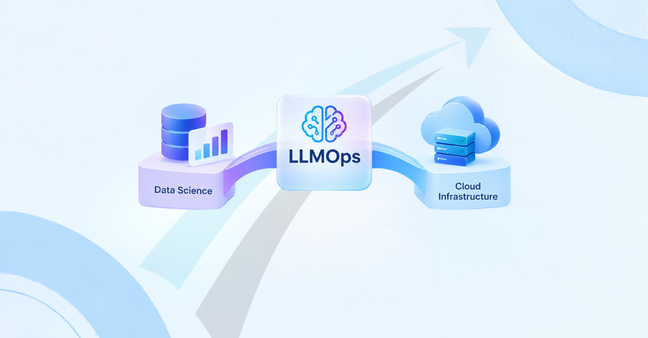
The most significant and speedy change that Generative Artificial Intelligence has brought in the world of software engineering is the transformation of architecture. Creating a proof of concept (POC) with the use of an API endpoint or a local transformer script takes only an afternoon of work, while scaling that model to be resilient and operating at high concurrency in a production environment is very difficult not to get wrong. While moving from the initial demo to a real data in the cloud, engineering teams constantly encounter these challenges: inference latency suddenly shoots up, compute charges soar in the thousands of dollars per month for GPUs, model responses are nondeterministic, breaking downstream parsers, and data privacy leaks endangering enterprise compliance. This friction is rooted in generative AI being right smack dab in the middle of two historically disparately managed domains – statistical data science and deterministic cloud infrastructure. The challenge that arises is: How does one connect the two arms of the chasm, where LLMOps or Large Language Model Operations steps in? The question here is: How can one bridge this operational gap!
Traditionally, data scientists worked in an "exploratory and stochastic" manner -- tuning context depths, embeddings, and weights, within a single notebook. Cloud and DevOps engineers on the other hand emphasized deterministic system guarantees: 99.99% uptime, tight network isolation controls, automated system rollback and close infrastructure budgets. LLMOps brings these complementary disciplines together into a repeatable, automated engineering field, capable of robustly deploying generative AI in production.
1. Evolution of Operational Paradigms: DevOps vs. MLOps vs. LLMOps
For the massive transformations in operations engineering required by foundational models, we need to explore three stages of their operations.

Traditional DevOps (Code-Centric)
Traditional DevOps arose to automate the deterministic application code's compile, test and deploy. The software artifacts are version controlled via Git, fully tested using automated unit/integration test suites and are packed into lightweight containers. The system is deterministic: two or more systems with the same code generate the same results respectively.
Classical MLOps (Model-Centric)
By adding machine learning-specific capabilities to DevOps, MLOps helped to overcome the limitation that software behavior is determined not only by code, but also by data. However, MLOps adapts a new data validation and when distributions in the real world change, custom tabular or computer vision models can be affected and get worse with time, hence the adoption of feature stores, automated data validation, model registers and scheduled retraining pipelines.
Enterprise LLMOps (Foundation-Model & Context-Centric)
LLMOps tailors the large-scale, hundred or even billion-parameter, pretrained Foundation Models. Instead of building models from the ground up, operations engineers control prompt lifecycles, orchestrate dynamic context ingestion (RAG), manage the vector database indexes, set real-time safety guardrails, and boost GPU inference speed with respect to varied token traffic.
Comprehensive Paradigm Comparison Matrix
The major differences between infrastructure, testing and costs are summarized in the table below:
2. The Five Architectural Pillars of Production LLMOps
Reliable use of LLMs on enterprise clouds requires carefully designing the five interdependent operational levels:

Layer 1: Prompt Engineering, Versioning & CI/CD
Prompts are pieces of code that can be executed. Structured JSON outputs can be affected by breaking syntax from a single unintentional change in a word.Structured JSON outputs can be influenced by breaking the structure of the output via an unexpected word change. LLMOps views prompts as version-controlled artifacts of code—with automated regression tests suites and semantic assertions being run as part of CI/CD pipelines before they go into production.
Layer 2: Retrieval-Augmented Generation (RAG) & Vector Data Infrastructure
RAG seamlessly interconnects pre-trained models with company-specific data without costly fine-tuning. Cloud engineers work with workers for automated document parsing and chunking, build high-throughput vector database clusters (such as Qdrant, Milvus, pg-vector), and implement semantic caching layers (like Redis, GPTCache), which reduce API calls by up to 70% since the data has already been processed.
Layer 3: Model Serving, Quantization & GPU Orchestration
Self-hosted Open models like LLaMA 3, Mistral or DeepSeek require dedicated inference runtimes. AWQ, GPTQ, FP8 are quantization techniques that enable the deployment of big models on cost effective GPUs with minimal performance loss, while vLLM (based on PagedAttention) significantly decreases memory fragmentation.
Layer 4: Real-Time Guardrails & Enterprise Security
Security guardrails real time user prompt and outbound responses inspection. Tools such as NeMo Guardrails and Llama Guard can be used to sanitize the prompt to defend against jailbreaking and leaking PII, and consistent formatting in the JSON response can be enforced with deterministic parsing libraries like Outlines and Instructor.
Layer 5: Continuous Observability, Telemetry & Evaluation
Generation quality is too complicated to evaluate at the standard APM. LLMOps-based pipelines come with dedicated telemetry metrics like Time to First Token (TTFT), Inter-Token Latency (ITL), the number of tokens per user, and automated LLM-as-a-judge pipelines that regularly check hallucination rates and response relevance.
3. Architectural Decision Matrix: Commercial APIs vs. RAG vs. Fine-Tuning
When making a decision about an LLM deployment strategy, several factors come into play including operational complexity, data privacy, latency, and costs:

4. Bridging the Career Divide: Going from the Outside-In to AI Engineering.
The use of generative AI and cloud has become the most in-demand specialization in enterprise computing today. The success demands the joining of the statistical expertise of cloud data science, and the operational discipline of cloud engineering.
Data Scientists upskilling Path.
It's impossible to use only standalone Jupyter Notebooks for enterprise engineering anymore. The appearance of Docker containers, Kubernetes, CI/CD and API gating has made Data Scientists more valuable and valuable than ever before, to become Machine Learning Engineers. The Data Science & AI Program is a holistic program that allows aspiring professionals to acquire in-depth knowledge of model optimization, RAG architecture, and production pipelines.
Upskilling Path for DevOps & Cloud Engineers
Specialized AI acceleration workloads are driving enterprise cloud infrastructure to rapidly shift away from traditional applications. This course equips DevOps specialists with the capabilities needed to become the valued AI Platform Architects who master GPU node provisioning, vLLM/Triton serving runtimes, and distributed vector database clustering. Within the DevOps & Cloud Computing Program, you can learn how to leverage cloud infrastructure, container orchestration, and automated CI/CD.
Upskilling Path for Automation Specialists
Operations staff will need to track stateful memory loops, manage permissions for tool access and design resilient fallback pipelines as they handle operations within an autonomous multi-agent framework (like CrewAI, AutoGen, and LangGraph) moving into enterprise workflows. Take your exploratory journey into this promising field of study, with the course Agentic AI & Automation all special focused on it.
Alumni Experiences & Personalized Advisory
Take a look at real Alumni transition stories on the Sky Reviews Student Success portal to understand how they have managed to make successful career changes into sky news' high growth Cloud and AI careers! Having direct contact with the Sky States career team can provide customized comments on your technical expertise, as well as information about which roadmap of certifications would best support your career aspirations.
5. Frequently Asked Questions (FAQ)
What is the fundamental difference between MLOps and LLMOps?
MLOps is about the life cycle of traditional predictive models, that is, feature stores, and build your own predictive model, from tabular predictions to statistical drift, but LLMOps is about pre-trained foundation models. The confusion challenges that arise in LLMOps focus on prompt versioning, scaling of vector databases, cost control of tokens generated by LLM, dealing with hallucination, and using Paged Attention, and quantization of GPU memory.
How can organizations effectively control surging GPU and inference costs?
With three production pillars, Cost Reduction works as follows: (1) Semantic Caching serves stored answers for semantically equivalent queries with Redis or GPTCache; (2) Model Quantization (AWQ/GPTQ/FP8) lets smaller, cheaper GPUs host large models; (3) Dynamic Routing directs simple user queries to lightweight 8B models, and keeps the more expensive 70B+ models for complex reasoning.
What are the critical latency metrics required for streaming LLM applications?
As opposed to typical rest APIs, which report on the overall time to a successful response, streaming LLM applications measure Time to First Token (TTFT, which dictates how quick they are to see the first token from the model), Inter-Token Latency (ITL, how quickly tokens are sent back by the model), and Tokens Per Second (TPS, how many tokens the GPU delivers per second for multiple requests).
Can existing DevOps engineers easily transition into LLMOps roles?
Yes. DevOps engineers are familiar with the hardest-to-master infrastructure elements—such as Networking, Cloud Security, Linux kernel internals, CI/CD automation, and Kubernetes orchestration. Containers optimized for GPUs (NVIDIA Container Toolkit), vector indexing algorithms, embedding generation and tokenization are the only concepts needed to grasp the AI layer to master it.
6. Key Takeaways for Modern Engineering Teams
1. Treat LLMs as probabilistic engines requiring deterministic guardrails, rather than simple plug-and-play REST endpoints.
2. Implement strict version control and automated regression test suites for prompts and system instructions.
3. Prioritize your retrieval architecture before modifying model weights; 80% of enterprise RAG failures originate in poor document parsing and vector indexing.
4. Bridge the talent gap by combining the statistical domain expertise of data scientists with the rock-solid reliability of DevOps infrastructure.