Data Science & AI: New York career roadmap, skills, jobs & training guide
.Sky States Technical Content & Career Guide Series
Data science is a cross discipline approach where different principles of statistics, cutting-edge computing and subject-matter knowledge are used to generate valuable insights from the raw data. The essence of data science is the ability to take raw, unstructured and unorganized data and turn it into simple, actionable predictions and strategies that ultimately guide business decisions. From making tailored personalized streaming recommendations to forecasting supply chain delays to executing fraud-detection models, data science is in the middle of the action when it comes to today's decision-making.
Data Science is based on concepts and business value of data
The Easy Introduction to Data Science Field.
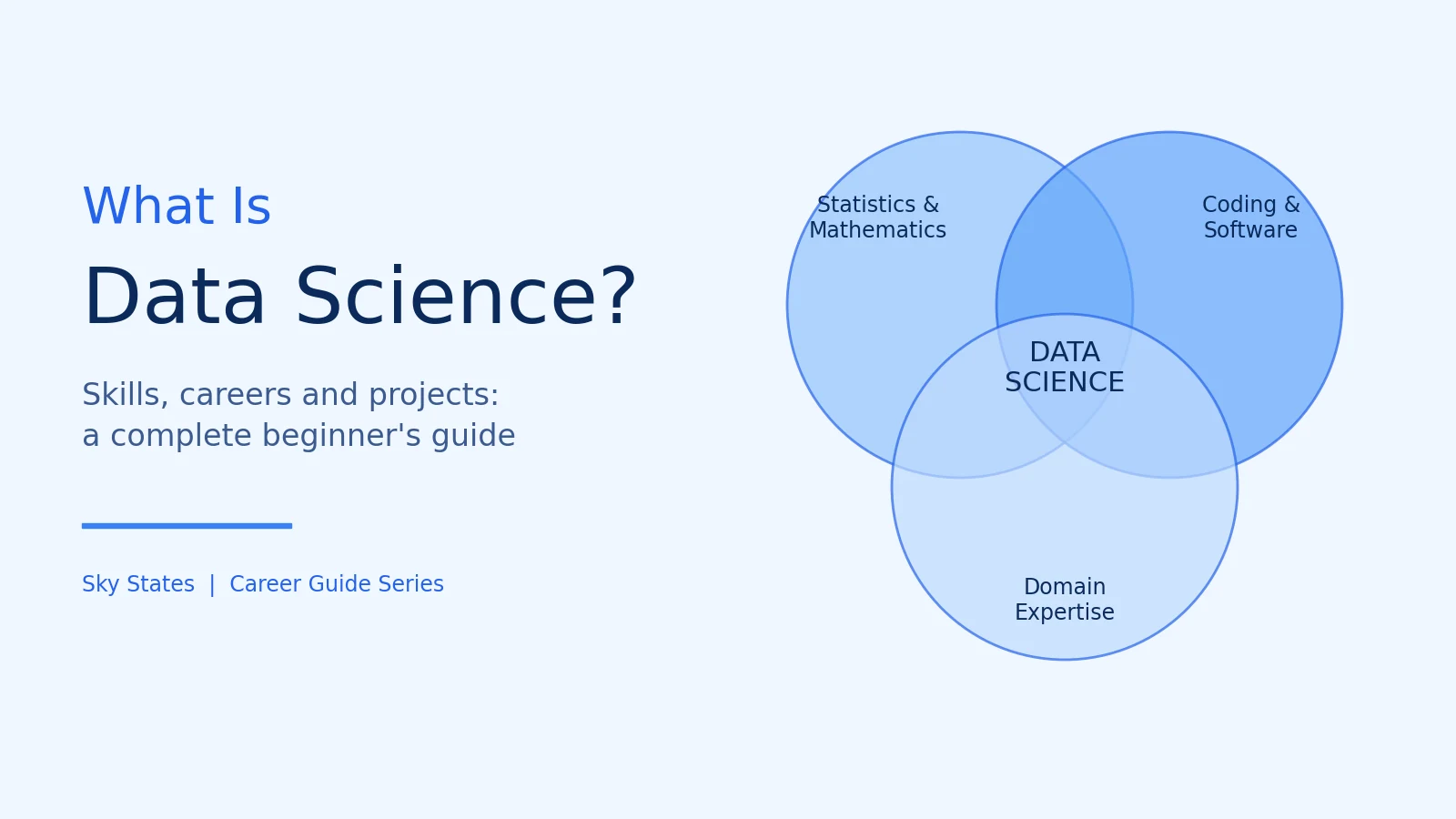
Data science, in the most basic sense, is asking the "right" questions and then answering them by leveraging data. It's more than just coding or solving the math problem, it's actually a 3-way combination:
Statistics & Mathematics is an analytical column to uncover patterns that are not obvious, to measure risk, and to test hypotheses.
The technical toolkit on Coding and Software Development is a method which can be used to clean data, develop an automated algorithm, and process information on a large scale.
Domain Expertise: Understanding of the domain to comprehend business problems, comprehend the outcomes and change raw data into business insights.
What is Data Science and why it is important?

Raw data is the raw oil, it has a lot of potential, but until it is processed it can do no work. Data science is anything related to creating real value out of this raw material:
1. Collection & Ingestion: Data is gathered from web logs, customer transactions, sensor networks or from external APIs.
2. Cleaning & Preprocessing: Duplicating data, filling missing values, formatting data for analysis of messy data.
3. Exploratory Data Analysis (EDA): Statistical summaries and visual graphs to find trends, correlations and anomalies.
4. Predictive Modeling: Prediction of future phenomena, trends or events using algorithms.
5. Business Translation: Getting complex outputs across in actionable business communication to Executive, Product Manager & Team Leaders.
If this pipeline is not in place, companies are doing business on a gut feeling. It can enable companies to optimize prices dynamically, deter before it's too late which could cause customer loss, and make regular business decisions automatically.
The Data Ecosystem is a collection of tools that enable key comparisons.
Gaining an understanding of the relationship between the data roles will allow you to choose the learning path and career objective that will be appropriate.
1. How are Data Science and Machine Learning different from each other?

While it may be thought of as being synonymous with data science, machine learning is actually a part of data science.
Data science is the entire construction of a house – ML is the high-tech automatic heating and electric system in the house.
2. Would you prefer to be a Data Analyst or Data Scientist?
Both the professionals are data-oriented, but have very different technical scope and focus.
Data Analyst (Descriptive & Diagnostic Focus): Answer questions relating to past and present – ‘What happened and why did it happen? They write SQL queries, build business intelligence dashboards in Tableau/PowerBI and deliver executive summaries of historic sales or traffic to management.
Data Scientist (Predictive & Prescriptive Focus): Solves questions about the future: 'What will occur next and how could it be optimized? Data scientists develop machine learning algorithms, create production software in Python, evaluate risk factors, and continuously conduct A/B testing.
3. Data Science or Data Engineering, which to learn first?

It will aid in understanding infrastructure and outputs with selection of starting point.
Data engineering: plumbing. Data engineers create and manage data pipelines, data warehouses and database architectures to securely transfer data from source systems to an analytic environment.
Data Science: Emphasis on the analysis. When the data is cleaned and properly structured by the data engineer, the data scientist can use the data to find patterns, make predictions and create predictive models.
Where to begin? Data Engineering is a great place to begin if you have an interest in the back end software development, database administration and system design. If you like to work with data, solve a real world problem, explore the data and create predictive attributes, then Data science is for you.
Counselling and experience on coping with the job market.
This is a task not to be accomplished through the rote learning of theory. Instead of skimming through numerous listings of skills, managers who are looking to fill a data science position quickly check to see if they have practical examples demonstrating skills in action.
When it comes to a top data science position, a personal portfolio is invaluable when going to see a candidate. Employers are looking for a clear documentation of the data science process from real data collection to missing data to predictive modeling to business impact.
Mastering python for data science is crucial to successfully complete these projects. Python is constantly updated, but it is still the industry standard language because it has many open source packages that can be used for data manipulation (Pandas), numeric operations (NumPY), custom visualisations (Matplotlib and Seaborn) and machine learning pipelines (Scikit-Learn).
This is related to Frequently Asked Questions (FAQ)
Q: What skills do I need to become a data scientist?
The first step to a data scientist career is to hone a mix of technical and analytical skills:
1. Programming: Strong abilities in using Python or R with data sets and statistical models.
2. Database Management: Good SQL knowledge – reading, filtering and joining relational databases.
3. Statistics & Probability: Knowledge of regression analysis, hypothesis testing, probability distributions and confidence intervals.
4. Machine learning: Please have a good understanding of supervised and unsupervised learning algorithms such as linear regression, decision trees, random forests, clustering.
5. Data Visualization & Communication: Ability to present analytical findings in a meaningful story points through Windows Tableau, Matplotlib or Power BI.
Q: Which tools and programming languages are most used in data science?
The reason for Python being the industry leader is its ease of use and the libraries. R continues to be widely used for statistical studies. Common tools include:
• Data Processing: SQL, Pandas, NumPy
• Create data visualizations with Tableau, Power BI, Seaborn and Matplotlib.
• Learning Objectives: Apply machine learning & AI concepts techniques using scikit-learn, TensorFlow, and PyTorch.
• Students are also introduced to the following environments in the class: Jupyter Notebooks, VS Code, Google Colab
Q: What are common real-world applications of data science?
Applications that leverage data science are used in almost all industries:
• E-Commerce: Personalized product recommendations and real-time pricing.
• Finance: automated credit risk scoring, fraudulent credit card transactions detection.
• Dairy and Food: Identifying pictures of dairy items that might have food poisoning or have decayed.
• Manufacturing: Examining pictures of products in order to detect defects before selling.
• Logistics: Optimization of delivery routes, plans of vehicle maintenance and stock management in the warehouse.
Q: How is data science different from data analysis?
Data analysis primarily involves the study of trends that occurred in the past in the context of 'what', and 'why'. Data science also looks forward by employing sophisticated mathematical models, machine learning techniques and bespoke programming to predict future results and automate decision-making procedures.
Q: How long does it typically take to learn data science?

Core job-ready skills are developed in 6 to 9 months' (about 10 or 15 hours per week, often in a structured way) consistent and structured study. Guided programs, small group sizes and practical project mentoring can greatly simplify the activities.