Data Leakage in Machine Learning: Causes, Examples, and Prevention
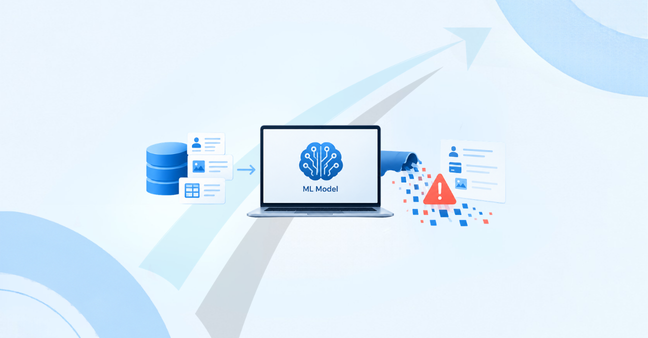
Data leakage in machine learning is when a data set is used for training or evaluating a model but is not the kind of data that would normally be used for a prediction. During model training when data leakages occur, the model might look great while it doesn't work well when presented with new data. Below are data leakage examples to check: Definition of prediction moment, checking availability of features, splitting, preprocessing and evaluation.
What Data Leakage Looks Like in a Real Machine Learning Project
A good model mimics patterns that can have been formed when it is put into profit. Leaky models get an unfair hint. For instance, a subscription-churn dataset can have a cancellation completed field which was only added after the customer has cancelled his subscription. The model can learn the result and not predict it – one of the most common types of machine learning data leakage. If the information in the test set is used to determine features, feature preprocessing, or model selection, you cannot assume a high test score is meaningful.
Four Common Causes of Data Leakage in Machine Learning
Target Leakage: When the Answer Is Already Hidden in the Data
Target leakage occurs when a feature provides information about the target, or information about an event that was made after the event. The result could be revealed in a cancellation confirmation in a churn model. Get rid of it or recreate the dataset based on knowledge acquired at prediction time.
Preprocessing Before the Train-Test Split
Imputers, scalers, feature selectors and dimensionality-reduction techniques acquire knowledge from data. If they are put on the entire dataset, then the test set aids in determining those transformations to some extent even though it does not contain labels. Split the dataset, fit it a transformation and validate and test with that fitted transformation. It's a well-known mistake used to cause train-test leakage.
Create a copy of Records and Related Samples Between Data Splits
You can place the same example (as a duplicate) in training and testing. This is true when information moves across a split from one customer/patient to another device and one household to another customer/patient. Also consider group-aware splitting with respect to test for generalization to entities not included in the training set, as well as near-duplicates.
Future information from time-series and real-time predictions.
No Friday feature can be used in a Monday prediction. Leakage may occur from another aggregation, the re-entry of records as they are made later or changes to post-observation status fields related to earlier observations. Divide chronologically, and check the existence of all of the features before the prediction time.
 Figure 1. How evaluation teases out the truth by bending it so it doesn’t fit.How evaluation distorts the truth and how data can be split more safely.
A Practical Example – auditing a Customer Churn Model
Let's look at an example of a subscription based service making predictions of churned customers. The very basic one relies on monthly usage, support contacts, plan type, and `cancellation_confirmed`. Test performance seems pretty good, then the team finds that the ‘confirmation' field is being created after the fact (cancellation). The model is reading a key to the answers.
This team clears that field and then gets it ready as it was at the time the prediction was made and tests a second time using proper splitting. While it can be lower, it's more convincing since they're using signals that came before the scoring.
How to Avoid Data Leakage Before a Model Goes Live?
Explore unusual scores, improved performance on "random" than on "time" or "group" aware splits, or performance after a specific time, across splits, separate records, or sudden drops on unseen records. These signals point to locations but on their own, are not evidence of leakage.
Ensure that all features are released at prediction time before release, transformations are only worked on training folds before release, there is no cross-splitting of related records before release, the record used for evaluation fits the real use scenario before release, and that the final test set has not been touched during the tuning process before it becomes a real use case.

Figure 2. 5 checks prior to relying on the model results.
How to Prevent Data Leakage in Machine Learning
The following workflow can be used for ML to avoid data leakage:
1. Set a target for the interfacing, and for the errors.3. Set target and prediction time.
2. Review the source of and the timeliness of each feature.
3. Divide before adding transformations and/or picking features.
4. Apply a scikit-learn pipeline; this allows to learn preprocessing within each training fold.
5. Select group and/or chronological splits if required.
6) Ensure that the cross validation folds are separated.
7. Make an undamaged last test set for the completed model.
8. Document versions, features, splits, and transformation of datasets.
Safely deal with missing data, safe to scale, safe to fit the model with a short pipeline for ordinary classification data with independent rows and numeric features:
The pipeline is trained on the training dataset to learn imputation values, and scaling parameters, while then soaking up test data and applying the learned imputation values and scaling parameters. In this case, 'score' gives the percentage of accuracy of this classifier. The example relies on a numeric feature on the data, and assumes a random split is appropriate.
A different splitting strategy is needed for grouped or time-series data. Pipelines mitigate some of the pre-processing loss of information problems, but cannot solve the problem of future information in a single feature or the wrong evaluation design. For more detail see the Sklearn insider tips on common mistakes.
Data Leakage vs Overfitting: What's the Difference?
When the model learns the noise or does shallow learning, the learning is called overfitting. Data Leakage takes place when information enters into the training or evaluation process in an inappropriate way. Are different problems, but do happen simultaneously: Leakage can make an overfit model appear even more correct than it really is.
Target Leakage vs. Feature Leakage
It's easier to build a model to predict if a refund will be issued in Target leakage: a "refund issued.field" reveals an outcome. Feature leakage can mean various things on different teams: features that could be leaking in an indirect way; data that is being transferred across an evaluation boundary. Center attention on the concrete question: If it is the “yes or no” question, does the feature provide information that can't be known for a reasonable prediction?
Creating a more reliable Machine Learning Workflow
In the absence of confidence in the result, check feature timing, use the correct split, only use training data to perform fit preprocessing, keep cross-validation distinct, and keep a final test set. This should be seen as a responsible model development process and not as a trick to increase metrics.
Reproducible preprocessing and deployment checks also link the process of developing the model with the same type of production engineering, including version control, automation, pipelines, and monitoring. For a wider path to learning over the associated DevOps and Cloud skills for infrastructure and automation, consider the DevOps & Cloud Computing Program.
Continue Developing Your Data Science and AI Skills
Reliable ML work involves making sure data is prepared properly, looking for assumptions, reviewing results, and comprehending how a model will be applied or utilized, rather than merely reciting algorithms. SkyStates' Data Science & AI Program is a 4-curriculum path to learning Python, Machine Learning, and Applied Data. As shown in the machine learning roadmap, there are various levels of progression from Python basics to deployment and MLOps.
If you are getting to know the LLM/ AI agent thing, the Agentic AI & Generative AI Program introduce more general subjects on AI. Access control and secure data handling are also important as they are not the same as “data leakage” due to unapproved treading of confidential information. To explore the Cyber Security & Ethical Hacking Program, visit the Cyber Security & Ethical Hacking section of security learning, and to see if the program offers training and learner-review information, check out SkyReviews.
Frequently Asked Questions
What are some ways to find out if a model has data leakage?
Analyze scanning violations such as suspiciously high scores, mark timestamps, compare random and time-aware evaluation, duplicate and split bounds. Then one tests the model with completely new data using the ‘ predicting setup’ intended.
What are the typical sources of data leaking in the process of feature engineering?
They could come from any of the following: field following the target; future rows aggregated; preprocessing applied on full data, but target-aware; target-aware feature selection; related records surrounding train or test sets.
So, how do I stop data leaking when using cross validation?
Place pre-processing, including the estimator, in a pipeline and fit transformations separately in each of the training folds. When necessary, maintain groups together; and do not use the final test set for feature selection/tuning parameters.
Is there any test or metric to determine data leakage?
There is no single measurement that is evidence of leakage. Surprising high performance, a sudden loss of performance with fresh data or a big difference between random and realistic splits may be some indicators that call for a feature and split audit.
I am splitting a time series but how to avoid leakage?
Practice on a previous time period, then test on a later time period. Compose features only using data available at every prediction timestamp and use a split between the splits where the use case demands.
What are the issues with data leakage in model evaluation?
It can be too rosy an appraisal as it enables the model development process to gain information which would not be available in actual use. This may result in a sub-optimal model being chosen because it fails to achieve the desired performance after deployment as compared with test results.
Conclusion
The foundation of a machine learning system without data leakage is correct data division and the selection of features and a more honest evaluation of the system. These exercises are designed to help develop robust models which work better in the real world. Enhance your data preparation and machine learning and AI strength with the learning opportunities at the SkyStates.